A company loses an average of 10% of its customers each year! While the causes may vary (no longer a need to be met, disappointment with the service, departure for the competition, etc.), the result is the same: your company must find a solution to compensate for these departures and not lose revenue.
Knowing the investment required to acquire new customers, reactivating your former customers is a strategic approach! Even if they no longer use your services, they are already familiar with your company, your expertise, and your working methods.
They will be more inclined to collaborate with you again for a future project. Today, we are giving you the steps to follow to reactivate your former clients!
*Source: Harvard Business School
STEP #1 – Identify your lost customers
To implement an effective customer reactivation campaign, you must be able to clearly identify which customers have left your company.
To achieve this, the daily use of a CRM will be essential. It will allow you to obtain a comprehensive view of your clients' history: when were their last transactions? How did your last interactions go?
By using the various targeting filters in your CRM, particularly on the date of activity of your customers, you will be able to identify your inactive customers. And thanks to the contact data collected for each customer, you will be able to personalize your reactivation campaigns according to their expectations.
If you need help identifying your lost customers within your CRM, check out our special CRM “KESTIO Questions-Answers” webinar!
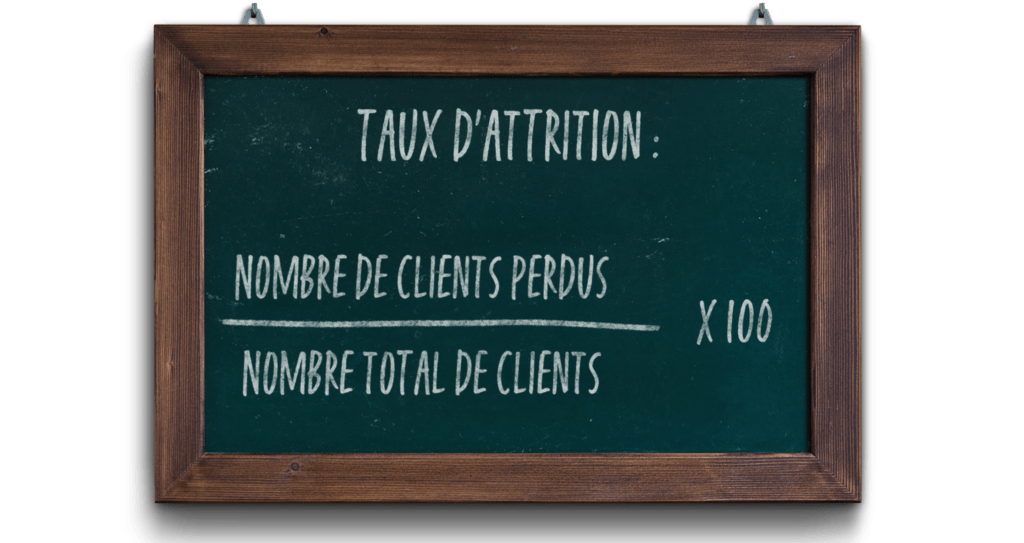
Thanks to your CRM, you will be able to calculate your attrition rate.
Also known as 'churn rate,' the attrition rate refers to the percentage of customers lost relative to your total number of customers.
Once the extent of your attrition rate has been measured, you can investigate the reasons for these departures and implement your recapture strategy!
💥 STEP #2 – Refine your value proposition
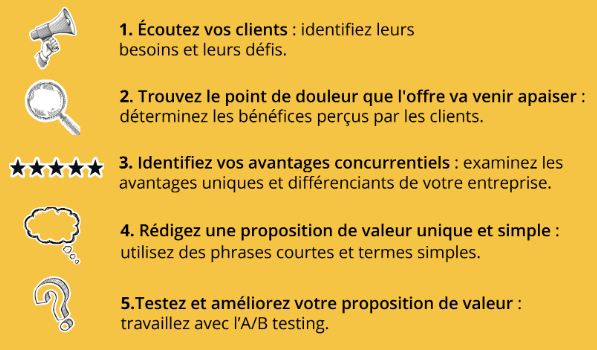
An essential step in a relevant marketing approach, the value proposition is the simple and precise formulation of the added value of a product or serviceas perceived by the customer.
In other words, it demonstrates the profitability (savings achieved, revenue generated) of the proposed solution and alleviates concerns about the risks associated with the project. By making your proposal unique, it allows you to stand out from your competitors and facilitate your client's purchasing process.
If the value proposition is not clearly identified by the customer, it may be the cause of its loss. If you are in this case, it is therefore essential to rework the wording.
How to build your value proposition?
Does your target audience understand your offer?
Are its differences clear?
Are the members of your company able to talk about it easily?
These are the questions that help identify whether your value proposition is effective!
The cost of acquiring a new customer is higher than that of reactivating old customers. It may be more effective for companies to recover lost customers. For this, relationship marketing appears as an interesting strategy to reconnect and develop a privileged and lasting relationship.
The goal will be to understand the specific needs of customers, their preferences, and their behaviors, to encourage them to trust you again and ensure the future of exceptional customer service.
There are several methods for implementing a relationship marketing strategy
to win back lost customers:
Customer segmentation: Use the data you have on your lost customers to segment them into groups, based on their needs, purchasing behaviors, and preferences. This will allow you to tailor your recapture strategy to each group.
Personalized communication: respond to specific needs, via social networks or emailing campaigns.
Loyalty program: consider setting up a loyalty program to reward returning customers and/or a referral system.
Customer service: Offer impeccable customer service to your lost customers by providing quick and effective responses to their requests.
Customer feedback: identify areas for improvement by sending out satisfaction surveys or implementing call campaigns.
By using these relationship marketing techniques to win back lost customers, you can also improve your retention rate and reduce the costs of acquiring new customers.
Acquiring a new customer costs 7 times more than retaining one.*
While acquiring new prospects is necessary for the successful development of your company, customer loyalty should also be a primary focus for you.
Indeed, investing in generating new leads without ensuring that they stay with you once they become customers is like trying to fill a leaky bathtub. At best, you'll need a continuous supply of new prospects to compensate for the loss of your customers. At worst, your investments won't be enough to maintain this balance, and your number of customers will fall!
What key elements should you focus on to ensure customer loyalty?
KEY #1 - Listen to Your Customers
But to know if your customers are satisfied (or not) with your services and products, you have to listen to them! Because the "voice of your customers" is what you have most precious! Their feedback can allow you...
– To improve your customer experience – To identify problems before they worsen – To optimize the targeting and content of your marketing and sales strategy – To evaluate your new ideas before launching them
Therefore, all departments of your company can benefit from customer feedback! How do you gather their opinions?
Voice of Customer
The "Voice of Customer" refers to a methodology for gathering the needs and opinions of your customers throughout their journey. The objective of this approach is to easily and regularly collect feedback from your customers in order to initiate optimizations!
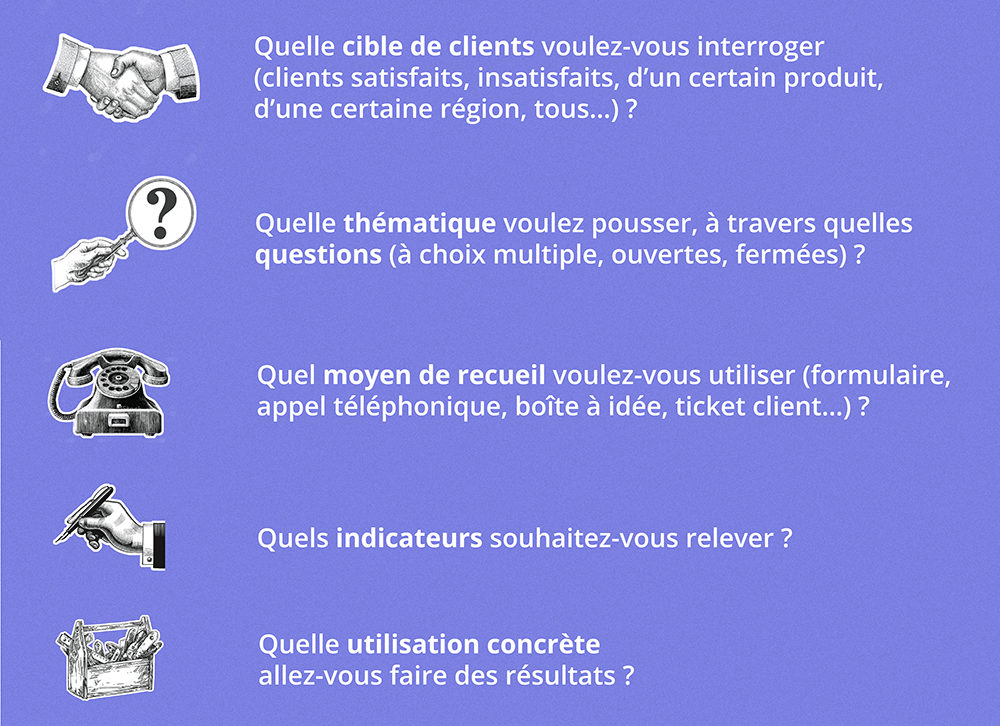
Discover the key questions to ask yourself to initiate a Voice of Customer strategy in your organization:
Want to start this process in your company? We can help!
At KESTIO, our Customer Success teams conduct customer satisfaction surveys every year using this Voice of Customer methodology.
Result? A customer satisfaction score of 9.34/10 in 2022.
Speak with a member of our team to begin the initial steps of this process!
KEY #2 - Customer Experience: the little extra that makes all the difference!
Customer Experience is one of the elements that allows you to optimize Customer Satisfaction. Based on perception and feeling, customer experience is more difficult to measure for each customer. To improve it, you must put yourself in the customer's shoes and understand what they are experiencing, or better, directly observe them in a relationship situation with the organization.
What is the customer journey?
It is a succession of points of contact with the customer. A point of contact is defined as an interaction between the customer and the company, via a specific channel, whether physical or digital.
The interaction can be informational or transactional, and triggered either by the company (push) or by the customer (pull). This includes reading an online or magazine advertisement, receiving a promotional email, visiting the company's website, entering a store, calling customer service, receiving a package, receiving an order confirmation email, receiving an invoice, etc. Note: depending on its customer types, the company may offer different customer journeys!
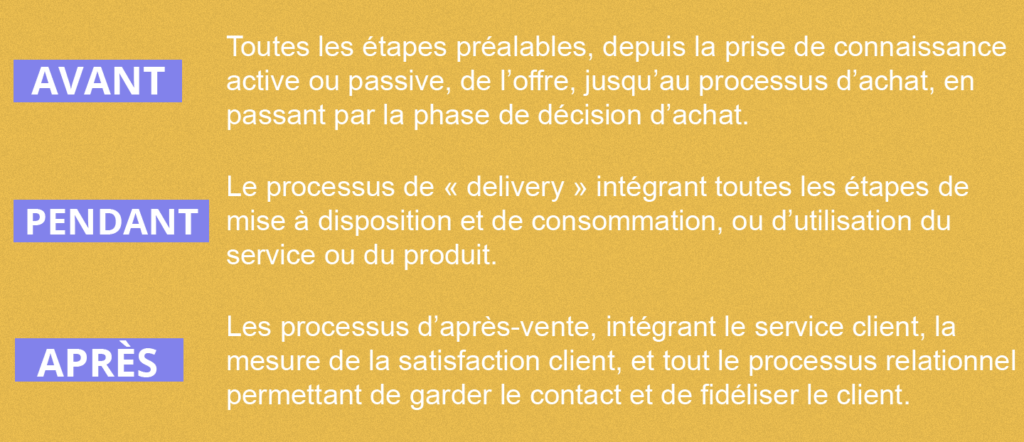
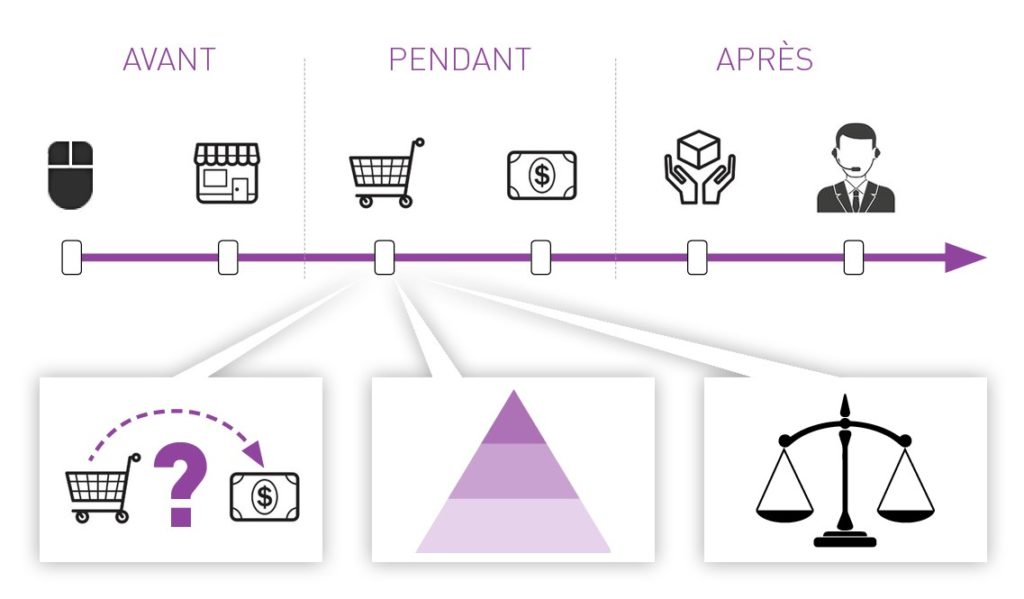
The 3 main phases of the customer journey:
For example, SNCF has worked extensively on Customer Experience in recent years. It has facilitated the customer journey by increasing the number of contact points allowing users to purchase tickets through their preferred channel: the website, the mobile application for smartphone users, the call center, ticket counters for customers who need advice, kiosks at stations, etc.
At the same time, it also works on emotion and comfort to create preference among its customers: welcome aboard trains, TGV magazines or others in first class, Grands Voyageurs reception areas, etc. So many services that should improve the Customer Experience from a global point of view over the entire journey.
Your goal is simple: a client who has a pleasant and distinctive experience compared to your competitors is highly likely to become a loyal customer, or even a brand ambassador. Customer journey, as the path taken by all stakeholders, Customer experience, a distinctive travel experience for your brand.
How to achieve this goal? To answer this question, let's compare the different types of Experiences that you can define and offer to your customers and their impact on your customers' feelings.
Your entire customer journey is located in theenchantment zone. You are truly attentive to them and constantly surprise them at every point of interaction.
Ah! The sweet dream of all Customer Experience managers…!
Unfortunately, this Experience is very difficult to maintain in the long term: from your company's perspective, the efforts deployed to reach this level of service are likely to generate costs that could potentially erode your margin. Or, you'll have to charge a premium for all these services... Which, from the customer's perspective, risks producing a perverse effect: they will quickly be convinced that they are paying for this level of service and that the Experience offered is not exceptional, but normal from that point of view! Their perception will therefore gradually fall into the "neutral" zone as your interactions progress.
So, if this sales strategy isn't the Holy Grail, what Customer Experience should you aim for?
Before going any further, it is necessary to make a digression on the difference between the Experienced Experience and the Memorized Experience. To illustrate this subject, it is interesting to look at a 1996 psychological study that examined the perception of pain (rated from 0 to 10) by different patients.
Here is an excerpt from the study:
Pain levels as described by 2 patients during a surgical procedure.
Anyone of sound mind would prefer the experience of Patient A over that of Patient B: an intervention that causes the same level of pain (a peak of 8), but lasts much less time.
However, when patients were asked to rate the average level of pain they felt after the procedure, it had nothing to do with an average of the different peaks.
The average described by each patient was more like the highest peak and the last moment of the operation.
Thus, even if Patient B's operation was longer, and therefore certainly less pleasant than Patient A's, Patient B retains a less "violent" memory of the procedure (we wouldn't go so far as to say more pleasant...).
This phenomenon, highlighted by Nobel laureate Daniel Kahneman, is known as the 'peak-end rule': the way individuals remember an experience is linked to its most intense moment and its ending. This digression sheds new light on what the customer experience should be like to be best remembered (and therefore lead the customer to be loyal and become your ambassador).
Discover KESTIO webinars, where we discuss
All topics related to sales performance with our experts:
In light of this study, one might think that a "neutral" experience is enough to ensure a good level of customer loyalty. However, this is not the case, as we will see, and for several reasons.
A neutral customer experience is often what most customers experience. It does not allow them to be loyal and at the first opportunity pushed by the competition, they will gladly consume elsewhere.
In addition, if an obstacle occurs during the process, they will retain a vivid image of this obstacle, and you will very likely have lost them for good.
Target key moments to delight the customer
As you will have understood, it becomes particularly important to ensure 1 (or even 2 or 3) key moments throughout the journey where you will delight your customers.
Firstly, to differentiate yourself from your competitors, and secondly, to prevent the slightest problem from causing you to lose your customers permanently.
In this example, the customer is very likely to overlook a rather disastrous purchase experienceand be pleased to have purchased a product that satisfies them every day.
Regarding the Importance of After-Sales Service
The "peak-end rule" theory also explains why it is very important to have an efficient after-sales service. This is potentially the last step in their journey, which will greatly affect their perception of the overall quality of the Customer Experience you have offered them.
Moreover, when we conduct workshops on this and ask people in the room to give us real-life examples of positive Customer Experience, 80% of customers tell an anecdote with a problem brilliantly (or surprisingly) resolved by customer service.
And do you know why? Because it always makes a good story to tell.
From Storytelling of the Customer Experience
All the stories we are used to seeing and hearing since we were little include a hero who starts from a rather flat (neutral) initial situation, goes through a moment of great difficulty (disenchantment), but ends with a happy ending (moment of delight).
The story is often even more successful if a mini moment of enchantment precedes the great disillusionment.
For your customers to remember the Experience you have given them and for them to tell their loved ones about it, it is therefore useful to design your journey according to this scenario.
Of course, we are not talking about creating moments of disappointment along the way, but about identifying the main stages where a disappointing experience can occur in order to counter it as quickly and effectively as possible so that your customers have a nice story to tell. :)
Did you know that 95% of your success is linked to your state of mind? To learn how to manage your emotional load more effectively, discover the Triad method in this webinar:
A strong digital customer experience has become a key factor in conversion. Today, over 80% of consumers research online before making a purchase. To capture their attention and guide them through to the point of purchase, your digital setup (website, social media, mobile app) must meet their expectations at each stage of their journey.
At the risk of missing out on a major tool for improving Customer experience, and therefore transforming leads into customers! Are you one of these brands? To help you check quickly, we've put together a checklist of customer expectations that your digital setup absolutely must meet.
Here are the 5 fundamentals not to be overlooked.
1. Have clear product information
Your digital system must first and foremost respond to the searches of Internet users preparing to make a purchase.
This is of course if they are searching for your brand or products, but also if they are doing a more generic search on the types of products you sell.
80% of Internet users state that they use the internet to find information before buying a product or service… a score that reaches 87% in the Paris region and 92% among liberal professions and senior executives, according to a study carried out by Ifop in December 2014, entitled “The impact of e-reputation on the purchasing process”.1
Consumers must be able to to find rich and relevant information about the products or services that interest them on your site and through your pages on social networks. Information that will help them make the right choice, online or in store.
Most websites fulfill this « duty of information » and present their products and services, but is this presentation really useful and does it contribute to conversion? Is the product sheet complete enough, with a structured argument and concrete elements? Is the price clearly displayed? And if it is not, is a redirection to a quote request planned? Can the visitor easily access informative content to help them make their decision (customer reviews, product tests, use cases, etc.)? For an e-commerce site, are the delivery and return conditions visible and understandable, including from mobile browsing?
Enrich your product sheets to improve the digital customer experience
A simple description with a standard photo is no longer sufficient. Today, a key aspect of optimizing user experience lies in the ability to support the client's projection: helping them understand the concrete benefits of using the product, creating an emotional connection, and guiding them through a smooth and engaging digital customer journey.
In this logic, the product page should not be an endpoint, but a lever within a broader digital strategy. It can be enhanced with complementary formats such as video tutorials on YouTube, thematic blog articles shared on social networks, or even inspiration galleries on Pinterest. All of this content supports a structured conversion funnel, fueled by an effective CRM and a logic of continuous personalization.
Finally, by combining these elements with an approach focused on customer satisfaction and an omnichannel customer service, you increase the chances of supporting the user at each stage of their reflection and therefore transforming them into a loyal customer.
Having a contact to easily reach customer service in case of questions or problems seems obvious... and yet, it sometimes feels like an obstacle course on certain websites! So much so that one sometimes wonders if it is not intentional! Proceeding in this way would be a very bad calculation on the part of brands: it is not enough to "hide" the telephone number or email address of customer service to escape questions and other discontent. On the contrary, there's nothing like it to fuel customer impatience and frustration!
Especially today, in a context where the multiplicity of possible contact channels has made it essential in the eyes of users and customers to have an easy and immediate way to contact a brand.
'While online shoppers are attached to traditional means of contact, they still want to have a choice when it comes to customer service,' explains a CCM Benchmark / iAdvize study from April 2015.2
Online shoppers particularly appreciate the usefulness of real-time assistance methods to help them during critical stages of the purchasing process: payment issues, difficulties with identification, or problems completing the order form.
Facilitate online customer support to streamline the purchasing process
Let's not forget: most of the time, when a customer visits a brand's website, in addition to wanting to buy/find out about a product, it's because they are looking for help. The first step to helping them necessarily involves a frequently asked questions (FAQ) section, which, if well done, will avoid a certain number of calls to your customer service department.
Similarly, being able to download documentation about your products or access tutorials (video or otherwise) will avoid a number of direct calls or requests on social networks.
Implement an omnichannel customer service that is visible and responsive.
Ideally, offer clients a choice in how they contact you, and clearly specify this, as IKEA or Michel et Augustin do on their contact pages.
Once these basics are in place, you can offer a way to contact your customer service directly: email, phone, chat or social media. Make the available channels immediately visible and easily accessible. Clearly explain who will receive the email or who will answer the phone. Confirm that a request has been received and announce how long it will take to process it. In most cases, this "educational" approach is sufficient or greatly contributes to lowering the tension level of a dissatisfied customer!
Finally, don't neglect social networks. If you have a presence on Facebook or Twitter, make sure that the person in charge of these accounts (ideally your Community Manager) can quickly forward requests internally, according to an effective and formalized process to allow a quick and relevant response, and a shared and « historicized » follow-up. You can also create a Facebook page or a Twitter account dedicated to customer service, so as not to mix engagement conversations and customer service conversations.
3. Benefit from all services on your mobile
In 2016, offering a mobile-friendly version of your website became an essential prerequisite. Why? Because 1 in 3 people worldwide now owns a smartphone.
More importantly:
"Traffic from mobile devices has recently overtaken that of computers: today more than 50% of internet searches are carried out from a mobile device (smartphone or tablet).3
Your customers are therefore looking for your products and consulting your site or online content half the time from their personal phones!
And there is nothing more frustrating on a mobile than a site that is slow to load and display with tiny buttons that are impossible to click... It has therefore become difficult to do without a site adapted for consultation from a mobile device, especially for e-tailers.
Optimize mobile navigation for a seamless customer experience
Meeting this expectation of your customers requires paying particular attention to the information hierarchy, the image formats used, the page loading time, and the ability to perform key operations (such as online payment or downloading high value content) from a mobile device.
Search engines (such as Google or Bing) now offer specific tools that allow you to quickly and easily test the compatibility of your website with mobile devices.
Responsive design or mobile application: which solution should be preferred?
Not everyone has the ability or resources to create a second version of their website specifically adapted for mobile viewing. The simplest, most effective, and least expensive approach is to design your main site with a « responsive design » : its content and presentation will automatically adapt to the device being used.
You can also offer your customers a mobile application. This should have a real added value compared to your website, and in particular provide solutions to customer needs in a mobile context. For it to be downloaded and used, your customer must also find it beneficial to use regularly. If the service offered by your application is a "one-shot" service, then it is better to implement it on your site in responsive design, optimizing the referencing of the page linked to this service.
4. Easily find the nearest point of sale
Your website, whether it is an e-commerce site or a showcase site, should serve as a bridge between your online and physical presence.
Before making a purchase on the Internet, more than 77% of 18-24 year olds admit to evaluating or trying the product directly in a store. The figure is 79% among 25-34 year olds.1
Conversely, before making a purchase in store, 73% of French respondents consult online consumer reviews on blogs, forums or consumer sites.
In short, physical points of sale and websites are more connected than ever and do not cannibalize each other.
Connecting website and point of sale for a coherent customer experience
It is therefore important to provide a list of your points of sale, or if you do not distribute your products yourself, a list of your distributors. Ideally, and in keeping with the logic of presence and use in a mobile context, helping your customers to quickly locate the point of sale closest to their current position represents a real value-added service.
Geolocation and mobile services: helping customers find your store
You have probably already had to geolocate your stores on Google Maps. But today, beyond giving access to the complete and interactive map of your stores, it is also useful to be referenced by the many mobile applications allowing you to automatically receive on your mobile the current promotions of a store when you are nearby (Groupon City Deal), or to accumulate points/bonuses upon entering a store (Shopkick). Or even, to compare prices for the same product in all the stores that sell it near your current position (Géocompare)!
5. Benefit from a personalized and, if possible, « augmented » experience
When customer information is clear and structured, contact is simple, mobile navigation is optimized, and store locations are easily found, a major differentiating factor for your site will be to integrate "personalized" features.
Personalization: a powerful lever to enrich the digital customer experience
Recognizing your client upon arrival on the site by greeting them by their first name, or prioritizing the display of product offers for which they have already shown interest, are all elements that allow you to re-create « proximity » online.
My FeelBack, for example, thanks a person by their first name and cites the name of their company in its message displayed after downloading one of its white papers.
Cultivate unique client relationships through tailor-made features
You can also offer content that adapts to the profile and browsing history, send a personalized message with a specific promotion following an "abandoned cart", or create spaces reserved for "premium" customers, allowing them to access value-added content...
Or even offer a "different experience" thanks to an original design, unique messages, as the Michel et Augustin website does well, for example.
Or simply offer them the opportunity to subscribe to a thematic mailing list, allowing them to receive key information in advance (e.g., the launch of season ticket sales for a football team's matches).
Such features improve the user experience, allow you to further refine your performance, and above all, offer a strong and memorable emotional impact for your customers.
But before considering deploying this final stage of the digital rocket, don't forget the fundamentals detailed in this article: to generate the 'wow' effect by anticipating your clients' conscious expectations, you must first meet their primary expectations on the essential points!
Was this article helpful to you? Share it 🙂
The impact of e-reputation on the purchasing process, IFOP, December 2014
Online purchasing behaviors and customer engagement, CCM Benchmark – IAdvize, April 2015
Uses and expectations of hyper-connected French people, Google – IPSOS, 2015
You've likely implemented best practices and drawn inspiration from leading models to consistently satisfy your customers. Perhaps, like 80% of businesses, you believe you offer 'superior or excellent' service quality to your customers...
The problem is that only 8% of your customers agree! (Lee Resources study). Enough said!
There is a real gap between your vision of satisfaction and the concrete perception of your customers.
How to ensure you really satisfy them? KESTIO offers you a list of four major fundamentals to master for an efficient customer experience.
1 – Truly understand your customers
What is customer satisfaction? It's the customer's assessment of the service provided by the company. When the customer feels that the quality of service meets or exceeds their expectations, everything is fine. Customer satisfaction is therefore determined by their own expectations and their evaluation of the commercial performance they perceive from the service. Not all your customers have the same expectations of you, nor do they have the same view of the efforts you make for them. Thus, a relationship identical in every respect will not be judged in the same way by two customers.
Having made this preamble, we can see how essential it is to know your customers well. Not in a general way, but on the contrary in a more detailed, individualized way. Depending on who they are, what they experience, and what they expect from the brand, a customer will not have the same judgment about your service. Having a "customer-centric" approach, placing customer knowledge at the heart of your efforts, is therefore essential to improve your satisfaction score.
Studies such as focus groups, customer surveys but also feedback from employees in direct contact with your customers, provide an initial vision of these elements. Tools such as personas, the study of expectations, or the definition of customer journeys are all useful approaches to share and keep the customer focus. Better still, having framework documents and compiling information from the field is essential to... structure your listening approach!
2 – Listen to your customers!
The evaluation of the quality of service (both real and perceived) inevitably involves... listening! Are you making efforts to structure your sales pitch? Do you have internal procedures for your approaches to clients, for your points of exchange? That's good. But also remember to listen to your customers. Why is this listening effort so crucial? Because nearly 98% of negative experiences do not result in any complaints. Customer "complaints" are therefore far from representing the level of satisfaction of all your customers. A low volume of complaints is not a sufficient indicator to prove that your customers are satisfied with your services. A restaurant that does not have (or has few) comments on a customer review platform does not necessarily inspire confidence. The same goes for your company.
It is therefore important to implement a comprehensive listening system that corresponds to your company. You need to find the right moments, the right questioning themes, and the right associated media and channels. What matters above all is that the elements captured are recorded effectively to be used. Listening alone is not useful. The feedback must then be used to change your habits, evolve behaviors, or even your products and services! These evolutions or considerations must also be visible to the customer to enhance their intervention.
3 – Place satisfaction at the heart of your effectiveness
Placing customer satisfaction at the heart of your organization and making it a driver of team efficiency and motivation is an innovative challenge for your sales strategy. It is not recommended to isolate customer satisfaction measurement and treat it as just another indicator monitored sporadically. Instead, making the information gathered from customers usable and concrete is essential. This openness allows you to:
Managing teams and raising awareness of customer culture throughout the company. Sharing indicators, which leads to an adaptation of the remuneration system, makes it possible, for example, to involve everyone in the efforts required.
Manage and enhance a consistent quality approach and processes through your sales management. With open data, the effort is collective, and the solutions adapt and correct themselves based on customer feedback. We don't operate in isolation but as part of a genuine 'team' serving the customer.
Optimize marketing campaigns through more precise targeting (specific emails to dissatisfied customers to win them back, promoting satisfied customers who know your quality, etc.);
Develop an offer that is truly and constantly adapted to the target through increased customer knowledge. The better you know your customers, the better you can identify their needs, and therefore optimize all the key indicators (conversion rate, order rate, recommendation rate, average basket).
4 – Use appropriate tools
Good customer satisfaction monitoring also involves choosing the right tools. Tools for measuring, collecting, and processing information, but also for sharing data. Good dashboards, easily readable and available, will help you streamline exchanges and make customer satisfaction that famous shared indicator, seen by all.
The selection and implementation of tools is a separate topic that we will develop in a dedicated article soon! Stay tuned!
To explore this topic further, we invite you to discover and download our White Paper:
Levelling of quality downwards, loss of product value and increased pressure on suppliers (On this point, see in particular our previous article Stop the price cuts... Focus on Customer Experience!). Generating profits through increased turnover and improved customer retention: this is sustainable, and it requires focusing on your customer experience. Today, companies that make profits and generate overall value are those that have understood that the customer is their primary asset, and therefore the primary lever to activate.
Wondering how to become a part of it? To achieve this, here are 5 tips to follow, based on the analysis of the winning strategies developed by leading companies in the field of Customer Experience. On your marks, get set... Perform!
1. Personalize the customer experience through intelligent data utilization.
Brands have never had access to as much customer information as they do today. The 'Big Data' buzzword refers to the vast amount of data that companies accumulate, which is still clearly underutilized.
An eConsultancy study conducted in 2015[I] reveals that nearly 80% of consumers say that brands do not know them as individuals.
How to change this observation? By taking ownership of this data and using it to enhance the customer experience. Here are some tips to guide you:
Establish multi-channel campaigns that are no longer solely designed based on the messages the brand wants to convey, but based on data derived from customer knowledge.
Carry out individualized nurturing by paying attention to behaviors, purchasing patterns, and interactions.
Involve your customers in product design, solicit their suggestions, and ask for their feedback on prototypes, using collaborative platforms and social networks.
Continuously improve the customer experience by leveraging the numerous methods of listening to and analyzing the voice of the customer now available: semantic analysis of comments made on social networks, real-time on-site observation, satisfaction surveys and cold statistics, predictive analysis of behavioral data, etc.
This personalization effort must be combined with an effort to rethink the messages and marketing pressure you will exert. Personalizing the customer experience increases the trust your customers place in you, and therefore their loyalty.
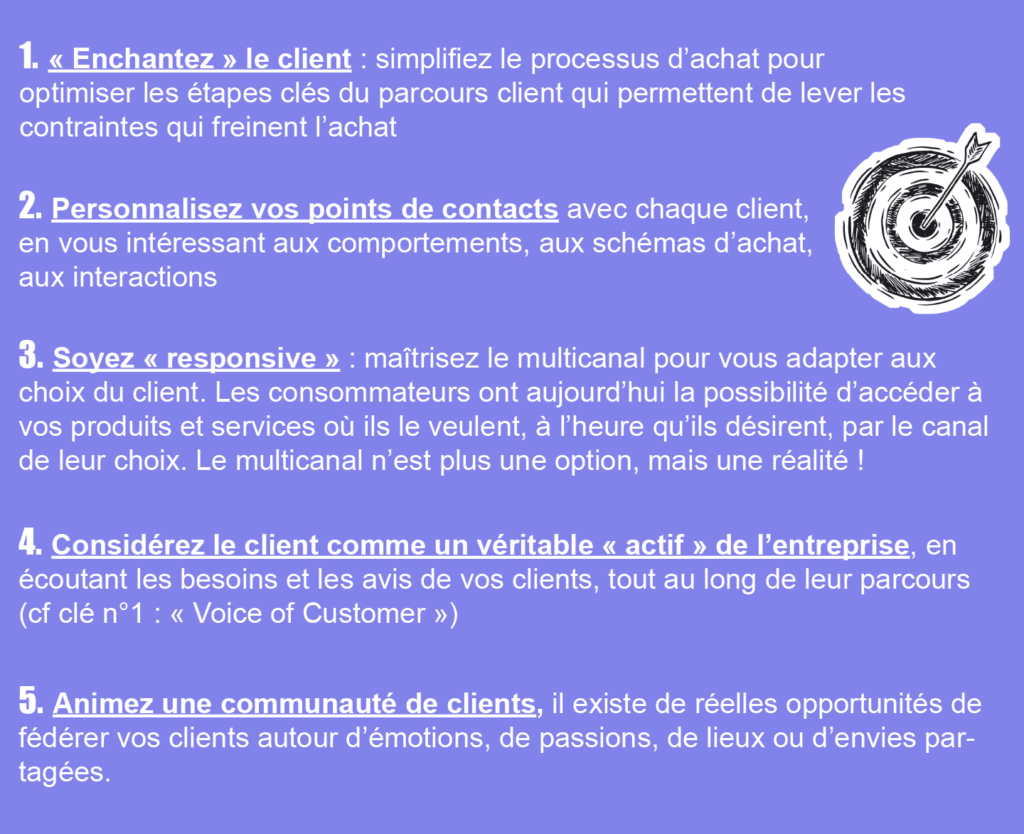
2. Be "responsive": master multi-channel to adapt to customer choices.
Consumers today have the possibility to access your products and services wherever they want, at the time they want, through the channel of their choice. Multichannel is no longer an option, but a reality.
Therefore, your entire company and all of your services must become "responsive"[II]:
Your strategy, first and foremost: adapt your offer according to the demands and new uses of your customers. Test small series, adjust and multiply.
Yourcustomer service, of course: after-sales service and technical support must be consistent (in terms of discourse and identity) and easily accessible by all means: from the website to the telephone, via chat, video tutorials and paper instructions. Adapt the messages and service delivery according to the media, but always with a concern for overall consistency of the customer experience.
Your services, finally: your customers like to order online and pick up in store or vice versa? Give them this option. Only a third of brands (34%) allow their customers to start a journey on one channel and finish it on another[III]. However, this practice is essential for better fluidity of thecustomer journey.
3. Foster a community of clients
Your customers are eager to be involved and want to share their experience! Don't believe it? However, in the age of collaborative consumption, and with digital word-of-mouth having a multiplied impact (both positive and negative...), there are real opportunities to integrate customer groups and unite them around shared emotions, passions, places, or desires.
The key to this community marketing is to encourage exchanges between consumers of a brand, around common values. Communication takes place between 'supporters' of a brand. Not only via social networks: also consider creating 'quality groups' with representative customers to constantly rethink and improve their purchasing experience.
Offering your customer community the opportunity to develop a connection based on passions or desires, and not just raw information about your products, is a very strong loyalty driver, much more powerful than loyalty cards. The customer feels « engaged » with the brand and therefore becomes your most effective ambassador.
Going beyond the reward logic linked to the level of purchase, creating a feeling of belonging to a group that loves and shares the same interests, developing a real community relationship... these are all levers that will engage the customer by your side.
4. "Delight" your customers: simplify and script the customer journey
A good customer journey is a simple journey! The trend, particularly with the contribution of new technologies, is towards consumer « relief » via journeys that are increasingly easy to understand.
According to the 3rd AFRC Customer Effort Barometer[I], across the 9 different sectors studied, 69% of the journeys assessed by French people did not require any particular effort.
A sign that brands are making progress in resolving issues. There is no shortage of examples of simplified purchasing processes, regardless of the channel used.
This reduction in customer effort through optimization of key steps in the customer journey helps to remove constraints that hinder purchase or limit loyalty. An efficient customer journey is a satisfying customer journey!
This wave of simplification will continue to intensify in the months and years to come with the arrival of connected objects. Because they are destined to enter consumers' homes, some connected objects will serve as a link, a bridge between the brand and its customers, to quickly resolve a problem, intervene, provide information... or reorder!
Enhancing the customer journey also sometimes involves small gestures, based on personalized marketing: your customers appreciate the small attentions you give them. A surprise box added to a package, a humorous message placed in an aisle, a unique ambient scent... These small touches will offer a surprising customer experience, a source of delight.
Hence – again – the need for particular attention to the proper use of collected data! Customers know they are entrusting you with personal data: they can be delighted by a relevant message sent at the right time... but conversely, an overly intrusive message, which shows a clumsy use of data, risks causing a resistant attitude.
5. Consider the customer as a true company « asset »
You must consider your client as an asset of your company, in the sense of a resource, in the financial sense of the term. The discourse heard, read and seen everywhere, which consists of « placing the client at the heart of concerns » must be translated into reality, because the impact of the customer experience on the acquisition and retention of customers, and therefore, in fine, on the revenues of your company is indeed real (as a reminder on the link between the quality of the customer experience and stock market performance of companies, reread our article: Stop the price cuts... Focus on Customer Experience!)
Companies that claim such a concern in their annual report and do not offer connected customer journeys, or do not use the customer data collected, are making empty statements that no one believes. Not even themselves.
How does a company truly demonstrate its willingness and ability to make the shift that positions the customer as an asset? Through projects and investments focused on improving the quality of thecustomerexperience (especially on the various topics covered previously) and by establishing, monitoring, and analyzing real performance indicators and return on investment.
The pursuit of continuous improvement of customer experience can only be achieved by adopting these indicators, which allow the company to adopt a strategy and make decisions based on facts. Quantify and qualify your efforts. Equip yourself with indicators to measure your progress, adapted to the objectives you are aiming for, to your sector of activity and to the maturity of your company in the face of customer experience.
[ii] Se dit d’un site internet au design responsive, c’est-à-dire qui a la faculté de s’adapter au terminal de lecture pour être consulté sur plusieurs supports différents.
For 10 years, KESTIO has been assisting companies – from SMEs to large corporations – in enhancing their Customer Experience to optimize customer loyalty and acquisition. We offer tailored support programs and exclusive methods to:
Thus, many French people report a more fluid relationship with brands than before, according to the 2015 AFRC Barometer of Customer Effort. However, French brands still seem unconvincing in terms of Customer Experience, as highlighted by the latest Customer Experience Index published by Forrester... Explanation of this apparent paradox.
1- Simplifying the customer journey, a first step in the right direction
"For 60% of French people, the Customer journey in France has become simpler, for the first time in three years" indicates the AFRC study conducted by Médiamétrie.
Truly good news that rewards the efforts of many companies committed to the continuous improvement of customer relations!
According to respondents, 69% of customer journeys did not require any particular effort. A clear improvement compared to the figures from 2014: at the time, only 60% of French people felt that brands made their lives easier. 9 points gained in one year is a significant progression to be delighted about!
However, this figure masks large disparities between sectors and depending on the stage of the evaluated journey. No sector stands out as the "big winner" of this trend towards improvement, but several of them benefit, particularly on specific points such as:
the use of loyalty cards for hypermarkets and supermarkets
Online purchasing in e-commerce,
The activation of a bank account
or even signing a new energy contract (electricity or gas).
It is noted that while the steps related to subscription or purchase have received a great deal of attention from companies in order to reduce customer effort, the same cannot be said for cancellation! The latter remains one of the most difficult moments in the journey for 41% of customers, especially in the insurance sector!
2- Multichannel Experience as an Enabler, Not a Replacement for Physical Stores
If customer journeys seem simplified today for many French people, it is mainly due to the facilitation provided by multi-channel approaches. In 2014, the rise of omnichannel was noted by the AFRC and became part of everyday life, but it raised concerns: the disappearance of physical and local commerce, and the complication of purchasing paths due to poor management of the different channels by companies (lack of coherence between them).
Today, these concerns seem to have largely disappeared, and consumers are demanding more. According to Eric Dadian, President of AFRC, as stated in the Les Echos newspaper:
" The freedom of choice has multiplied. The range of possibilities helps the consumer find the most suitable paths for them. The barometer also reveals that a portion of them would be willing to pay more for better quality customer service ».
Consumers have more choices thanks to the different channels, and still appreciate physical stores. Certainly, the web channel is cited first at 59% in the search for information, but visiting a point of sale (18%) is nevertheless increasing. This return to the store is palpable in certain sectors, particularly in telephony. French people prefer direct and personalized exchange when it comes to renewing their mobiles.
3- Yet, the Customer Experience is still far from satisfactory!
Can we say that all is well in the best of all possible worlds? That customer journeys are finally perfectly aligned with consumer expectations thanks to multi-channel approaches, and that their experience is significantly improved as a result?
The latest Customer Experience Index published by Forrester suggests otherwise! This annual barometer ranks 203 European brands from eight sectors based on the quality of their customer experienceand consumer loyalty.
In France, the winners do not get away with honors, since 55% of brands are classified as "mediocre" and not a single one of them delivers a superior level experience: MAIF, Yves Rocher and Crédit Mutuel Assurance, the three French brands that emerge as the best ranked in the index, are rewarded with a simple "acceptable". Mediocre results shared by other European countries such as the United Kingdom or Germany.
A disappointing observation, especially when you consider that 3/4 of French business leaders say that improving customer experience is at the top of their strategic priorities!
4- Why this seemingly paradoxical result?
The Forrester study indicates that the most important driver of customer experience quality is the emotional factor. Taking into account this "emotional" aspect in interactions and relationships with customers is what differentiates the notion of customer experience from that of customer satisfaction, for example (as a reminder on this subject, you can reread our article Are you sure you have mastered the 3 key approaches to building customer loyalty?).
It seems that this is where our companies are struggling, as they have primarily focused on the "efficiency" lever in their approach to improving the customer journey. Emotion is certainly a concept that they have more difficulty grasping: it is by definition less "rational" and therefore seems difficult to control and measure.
Yet, it is its systematic and lasting consideration that produces the most tangible effects and the most significant in terms of customer loyalty! Some sectors have realized this for a long time and are doing much better: this is particularly the case in the insurance and mutual insurance sector, from which 7 of the 13 best-rated brands in the Forrester index come!
While a significant step seems to have been taken in simplifying customer journeys, there is still work to be done in improving the customer experience. A challenge that requires careful consideration of the issue of customer listening and understanding: in the United States, a study published by IBM in the first quarter of 2015 indicated that 81% of surveyed companies believe they have a complete view of their customers, but that only37% of them say that the company really understands them... The gap is therefore very real, even if the difference is narrowing.
KESTIO supports numerous companies (from mid-sized to large corporations) on these topics:
Collecting customer data is no longer enough; you have to act on that data!
“Forrester predicts that 2016 will be a busy year for customer relations. It will be a year in which companies that make real efforts to improve customer relations will be rewarded, while those that have minimized their customers' needs for years will begin to decline,” says Forrester in its study « Top 10 Success Factors to Determine Who Wins And Who Fails in the Age of the Customer » (1)
According to this report, customers will reward companies that anticipate individual needs and use the data collected. Conversely, companies that constantly have to ask for basic information and are unable to "recognize" a customer will begin to lose them.
In short, Business Intelligence must create added value! Data collection must genuinely serve the customer experience!
Customers will no longer tolerate companies that appear to forget their preferences.
explained Gene Alvarez, managing vice president at Gartner, at the Gartner Customer 360 Summit in September 2015 (2). It is therefore imperative for companies to recognize their customers and provide them with relevant content that demonstrates a real effort.
Upholding confidentiality and privacy as a differentiating value.
Consumers are accustomed to brands collecting data and are more or less receptive to it. But one thing is certain: if personal information is collected, then these consumers expect it to be useful!
Consumers expect brands to use data before interacting! All your customers know that you collect data, and they will more readily accept the idea if it serves the experience they have with your brand.
To take action, data is necessary. However, be mindful of how you collect it. Data confidentiality and respect for privacy have become central issues. It's no longer sufficient to simply consider the 'legal' aspect, nor should data collection be seen as a risk. On the contrary, it's a real opportunity to stand out. It's important to educate and explain the purpose of the collected data and how it can personalize the offer.
Customer involvement will thus become a lever for improving the relationship! What does that mean? According to Forrester, brands that more strongly involve their customers – through their loyalty program, for example – will see the benefits.
Companies that launch customer-oriented operations will gain a real and lasting differentiation. Sticking to old habits is doomed to failure.
The customer must participate in defining the brand and designing its products and services: who is better placed than themselves to know their needs? This is what our client Castorama has understood very well: through questionnaires delivered via touch-screen kiosks placed in stores, some of its points of sale directly collect the opinions of their customers. This has allowed them in particular to adapt the hours of presence of their teams, to further improve customer reception and to develop new ideas based on reliable data obtained in real time.
Since the core of the customer relationship is based on personalizing and contextualizing the offer, it's important to strongly involve the consumer, ideally very, very early on. This is what our consultants contribute to, particularly when they implement an support program to improve customer experience.
But where to begin? What actions should be implemented and what objectives should be set? Discover here (in macro view) the five key steps that will allow you to design and then deploy an effective action plan to improve the multi-channel customer journey.
1. Define the scope
To begin, there is no improvement plan without a prior assessment of the starting situation! To improve the quality of the experience delivered to your customers, you must first measure the current level of quality and define the expected target level.
The first task therefore consists of defining the scope of the project, that is to say:
Target customer segments,
the stages of the multi-channel customer journey that you want to qualify as a priority,
the channels involved.
2. Formalize the Journey
Once all this information is gathered, formalize the different customer journeys (one for each segment) with all their stages and contact points. You need to identify the key stages and be able to immediately and clearly visualize on each of them:
the customer's actions and the channel used for each of them
the different levels of customer needs (explicit and implicit)
The choices the customer faces and their selection criteria
For each stage of the customer journey, the possible actions for the customer and the level of response provided by the brand must then be detailed very precisely and evaluated according to a scoring system.
You will then build:
your Optimal Experience repository which describes all the actions that can be taken to best meet the needs of customers,
an observation guide that will allow you to observe and note the quality of the Customer Experience
4. Measure the quality of the delivered Experience
Measuring the quality of the experience lived by customers can be done according to different methods of observation, analysis, and scoring. For more details on this topic, we refer you to the article: Do you know how to measure the Customer Experience delivered by your brand?
Depending on the context, available resources, customer segments studied, and channels analyzed, we will favor all or part of these different methods: on-site observation of the customer journey carried out by store teams, mystery shopping, analysis of website visit and navigation statistics, analysis of verbatim and customer reviews on the internet (social networks, forums, etc.), or even eye-tracking.
In all cases, the various studies carried out will ultimately be consolidated and analyzed to extract the average scores awarded to each stage of the journey.
We can then create a model of the brand's typical customer journey and determine for each step whether the experience lived by the customer corresponds to:
A disappointing moment
A neutral moment
An enchanting moment
Key moments identified during the definition of the customer journey will be studied with particular attention. The average scores thus established make it possible to identify the gap between the typical customer experience offered by the brand and the target customer experience that it has set for itself.
5. Prioritize optimizing key moments!
The identified gaps ultimately allow us to target priority areas for improvement. For each of these, recommendations should be made and an action plan established. The teams, involved from the client journey definition phase and then during the observation phase, can and should also be involved in building action plans in workshop mode.
The deployment and implementation of the action plan across the different stages of the journey, for each customer segment and on each channel, requires full and complete involvement of the various teams at each stage of the project. Prior awareness of the importance of the issues and the positive impact of these actions is therefore of crucial importance.
(If you haven't already, we invite you to rediscover the reasons why customer experience is a strategic topic and how customer delight impacts your profitability!). You likely already have an idea of the target customer experience you're aiming for, a vision and ambition in this area... But do you know where to start to achieve it? The starting point of this process invariably involves defining and optimizing your customer journey. Let's revisit the "fundamentals" of designing and evaluating customer journeys, the essential foundation for any customer experience improvement project.
1. By the way, what is the Customer Journey?
The customer journey encompasses all the stages and interaction points between a customer and a company, from the beginning of the purchasing process to the complete consumption of the product.
To simplify, this journey is characterized by 3 major phases:
BEFORE : all the preliminary stages, from active or passive awareness of the offer to the purchasing process, including the purchase decision phase.
DURING: the « delivery » process, encompassing all stages of making the service or product available, its consumption, or its utilization.
AFTER: The after-sales processes, integrating customer service, measuring customer satisfaction, and the entire relational process allowing to keep in touch and build customer loyalty.
The goal is to streamline the transition from AFTER to BEFORE.
In this sense, and even if they partially overlap, the customer journey differs from the customer lifecycle.The lifecycle is a much more macroscopic observation of the successive transition from the state of prospect to the state of active customer and finally to the state of lost customer. It can therefore contain several iterations of the customer journey, or even several journeys depending on the change in the customer's status.
2. What is the Purpose of Customer Journey Mapping?
In a customer experience improvement approach, modeling the customer journey is the first necessary step.
This enables:
Identify all the stages of the journey and all the pointsof contact between the customer and the company,
Determine the importance of each touchpoint in the customer experience.
to assess the company's level of response across these touchpoints,
todefine and implement the necessary improvements in relation to the level of response desired by the company.
While this approach was initially deployed for companies in the BtoC sector, it is increasingly being replicated and adapted to companies in BtoB.
3. Define the customer journey.
There isn't necessarily just one customer journey. Depending on its customer types, the company can offer different customer journeys: this is the case, for example, for companies that have an intermediary clientele with distributors, prescribers, installers, and end consumers, or those that want to offer a very different journey to their best customers.
A point of contact is defined as an interaction between the customer and the company, via a specific channel, whether physical or digital. The interaction can be informative or transactional and triggered either by the company (push) or by the customer (pull).
This includes reading an online or magazine advertisement, receiving a promotional email, visiting the company's website, entering a store, calling customer service, receiving a package, receiving an order confirmation email, receiving an invoice, etc.
A step in the customer journey is not always linked to a point of contact. It can be experienced in the customer's journey without direct interaction with the company. For example, a recommendation by a third party on a social network, travel and transportation to the company.
4. Evaluate the level of importance of the stage in the journey
Not all steps are equal in the customer experience. It is often said that the first and last points of contact in the journey are the ones that most shape the customer's feeling, whether positive or negative. There are also other steps, often the most delicate, which, together with the first and last impressions, represent the key stages.
We call these key stages 'moments of truth,' which, depending on how the company handles them, can turn a customer into a loyal one... or a lost one.
The challenge is to meet expectations, or even exceed them, during a critical moment for the customer.
Examples: receiving a package or the return process for an e-commerce company, presenting the bill for a garage, check-in upon arrival for a hotel, product availability for a store, defending a proposal for a service company, customer service accessibility for a transport company, etc.
Satisfactorily meeting the client's expectations at these stages is a cornerstone of building loyalty. Failure to do so encourages clients to leave.
5. Evaluate the level of responsiveness to customer expectations.
It is important to assess the level of satisfaction delivered, taking into account the expectations and needs of different types of customers. Because not all customers are the same, it is necessary to identify and create customer segments according to their expectations, and even, for certain sectors of activity, to personalize the journey.
A family does not have the same needs as a couple in a ski resort, an amateur handyman does not have the same expectations as a professional in a tool shop, and an SME does not have the same expectations for its car fleet management from a rental company.
It is also essential to consider a multi-channel approach to the customer journey, respecting customers' channel preferences, and an « omnichannel » approach, enabling customers to continue their experience seamlessly across all relationship channels and with all company contacts.
Throughout all stages of the customer journey, especially during critical moments, we assist companies in measuring how well they meet customer expectations. This helps them effectively define the actions needed to improve and streamline the journey, creating customer delight.
The WelcomeExperience® method offered by KESTIO allows you to
– define multi-channel customer journeys – assess the criticality of interaction points – evaluate the level of satisfaction delivered
in order to develop an effective plan to improve the customer experience.
Born from the experience and research of KESTIO consultants, this White Paper aims to present the concept of Customer Experience and its components, and to provide you with a methodological framework enabling you to implement effective Customer Experience improvement projects that generate loyalty and recommendations.
Why Customer Experience Should Become Your Primary Concern
How to Integrate Customer Experience into Your Customer Relationship Strategy
Keys to effectively deploying your multi-channel customer strategy
Benefit from viewpoints, study results, key figures, and feedback from our assignments with APRR and CASTORAMA. Discover concrete examples of implementation and excerpts from deliverables produced during our assignments.
1- La consommation collaborative : un phénomène qui bouleverse l’ordre établi
Le CtoC (Consumer to Consumer) ou consommation collaborative, au sens où on l’entend aujourd’hui, consiste à prêter, louer, donner, ou échanger des biens ou des services via les technologies et les communautés de pairs.1
La consommation collaborative n’est pas un phénomène nouveau en soi, mais elle a pris un essor considérable avec internet et la possibilité de se connecter à des milliards d’individus que l’on ne connait pas : le troc jadis pratiqué dans les villages devient désormais à portée de clic à une échelle mondiale, avec des moyens qui n’avaient jamais été techniquement imaginables auparavant.
Près d’un français sur deux est adepte de la consommation “collaborative” : 48% d’entre eux la pratiquent régulièrement, à travers la revente d’objets, le covoiturage, l’auto-partage, le troc ou encore la colocation, [selon un sondage TNS Sofres pour le groupe La Poste].
De nombreux secteurs de l’économie sont concernés : on pense immédiatement aux Taxis avec Uber, mais d’autres secteurs en ont fait l’expérience, comme le souligne Marc-Arthur Gauthey (entrepreneur et animateur du think tank OuiShare en France) dans un article publié dans les Echos :
«l’industrie culturelle [s’est] fait « naspteriser », « youtubiser » et finalement « netflixiser » il y a bien longtemps. Le monde de l’édition, puis à peu près toute la distribution, [s’est] fait « amazoniser » […]. La presse [s’est] fait « googliser » […], l’industrie de la connaissance [a] été « wikipédiée ». La SNCF, [se fait] « BlaBlaCariser » […]. Quant à l’hôtellerie, disons-le, [elle se fait] « airbnbiser » !
Ce phénomène à la fois culturel et économique est en train de transformer profondément les relations commerciales classiques et même les modes de vie : 8 Français sur 10 pratiquent ou ont l’intention de pratiquer cette façon de consommer.
Nous sommes passés d’un 20ème siècle d’hyperconsommation placé sous le double signe du crédit et de la publicité, à un 21ème siècle de connexions entre individus au sein d’une communauté élargie aux dimensions d’Internet et d’accès gratuit (ou à bas coût) à de nombreux services et produits.
Les nouvelles plateformes de mise à disposition des produits et services modifient à la fois ce que nous consommons, et la façon dont nous consommons : la consommation collaborative supprime dans bien des cas l’intermédiation (disparition du distributeur traditionnel) et provoque un déplacement de valeur de la possession vers l’usage, et du distributeur vers le producteur.
Une évolution majoritairement considérée comme favorable aux consommateurs, qui plébiscitent ce nouveau mode d’accès aux biens et services pour différentes raisons.
2- Les raisons du succès de ces nouveaux modèles
Pour les entreprises qui observent ce phénomène avec beaucoup d’intérêt, et parfois aussi avec une certaine appréhension (en témoigne la vague de panique au sein du CAC 40 après l’intervention de Maurice Lévy, PDG de Publicis, en décembre dernier au sujet de la « peur de se faire uberiser »), il est utile de se pencher sur les raisons du succès de la consommation collaborative. Au nombre desquelles on peut compter :
La maturité des consommateurs, tout d’abord : conscients de la part importante liée au distributeur, à la marque et à leurs dispositifs commerciaux et marketing dans le prix des produits, ils ne souhaitent plus avoir à payer pour ce qui leur semble superflu.
Une motivation économique : payer moins cher (en réservant une chambre chez l’habitant plutôt qu’une chambre d’hôtel, par exemple) ou générer de nouveaux revenus (en revendant des objets d’occasion sur le Bon Coin) est devenu central.
Une motivation d’ordre éthique : la conscience de l’impact environnemental et social de nos modes de consommation entre en jeu. Donner une seconde vie aux objets ou consommer local, c’est limiter son empreinte écologique et maintenir l’emploi près de chez soi.
Dans le cas d’Uber, on pourrait penser que seule la motivation économique entre en ligne de compte (et que le souci de “l’impact social” de nos modes de consommation plaide quant à lui plutôt en sa défaveur), mais il ne faut pas éluder un autre élément essentiel, qui « gêne » souvent les entreprises (ou les chauffeurs de taxis) aux entournures :
L’essor de la consommation collaborative traduit aussi une forme de déception et de lassitude des consommateurs vis-à-vis des acteurs “historiquement en place” et de l’expérience que ces derniers leur font vivre.
Trop occupées à produire toujours plus et toujours moins cher, à « pousser » leurs nouveaux produits à grand coup d’opérations marketing et de changement de packaging, les marques de référence ont (parfois) peut-être oublié l’essentiel : le sens du client !
Lassés de l’ « idéal standard » asséné depuis plusieurs décennies par les chaînes de restauration rapide, d’hôtellerie ou d’ameublement, certains segments de consommateurs menacent de délaisser les marques « historiques » au profit d’expériences plus humaines, plus individualisées et, disons-le aussi, tout simplement nouvelles et plus fun !
Mais les marques « historiques » ont-elles pour autant perdu d’avance face aux nouveaux entrants.
Téléchargez et découvrez notre livre blanc sur l’expérience client
3- L’Expérience client, le meilleur remède à l’ « uberisation » des entreprises !
Beaucoup de grandes entreprises sont aujourd’hui tentées de s’ « auto-uberiser » pour garder la main : lancement de plateformes de location/vente entre particuliers, ouverture de rayons « occasion » au sein de leurs magasins… Une stratégie essentiellement destinée à barrer la route, à court terme, à de nouveaux concurrents potentiels, mais dont le modèle économique doit encore faire ses preuves.
A long terme, la stratégie payante pour les entreprises sera de bien identifier où se situe leur proposition de valeur aux yeux de leurs clients :
proposer des produits et services utiles, pratiqueset facilement accessibles,
simplifier la vie des clients, leur faire gagner du temps ou économiser de l’argent,
résoudre leurs problèmes, répondre à leurs besoins
leur procurer des émotions positives ou du bien-être
… et les traiter de façon humaine et individualisée !
Il s’agit en fait pour les entreprises concernées, sur leur secteur et en fonction des spécificités de leur offre, d’identifier à chaque étape de leurs parcours client les points sur lesquels elles doivent améliorer l’expérience vécue par leurs clients.
Une fois les moments clés des parcours client identifiés sur l’ensemble des canaux utilisés, leur travail consistera à éliminer systématiquement tous les facteurs provoquant une expérience « déceptive » et à identifier tous les moyens à leur disposition pour générer de l’enchantement afin de les mettre en œuvre de façon systématique.
Nul doute que parmi ces moyens figureront des ingrédients largement présents chez Uber, Air BnB et Netflix, et qu’ils s’inspireront notamment des valeurs de l’économie collaborative !
Quelques exemples d’améliorations concrètes mises en place avec succès par des acteurs « traditionnels » sur leur secteur, et la tendance/valeur collaborative à laquelle elle se rattache :
proposer la location (parfois, longue durée) pour les produits coûteux à l’achat et d’un usage non quotidien ->valoriser l’usage plutôt que la possession
développer une application mobile performante et disruptive qui simplifie concrètement le parcours des clients -> innover et s’appuyer sur la technologie pour réduire l’effort client
mettre en place une plateforme collaborative d’échange d’avis, notes et conseils autour de l’utilisation de leurs produits -> avoir recours à la communauté de pairs pour trouver entre-aide et information
inventer une relation client qui dépasse les attentes conscientes ou les habitudes des clients -> vivre des expériences plus riches, plus humaines, plus personnelles
En un mot, les entreprises vont devoir « s’uberiser » dans le bon sens du terme, c’est-à-dire mettre en œuvre l’ingrédient ultime qui explique réellement le succès d’Uber et de ses congénères : une expérience client au top !
Ne nous voilons pas la face, et comparons simplement 2 expériences vécues :
Expérience Client #1 : J’appelle une société de taxis depuis mon téléphone, après avoir cherché son numéro dans les pages jaunes. Après un temps d’attente plus ou moins long, une hôtesse m’indique qu’un taxi sera disponible sur mon secteur d’ici 10 à 15 minutes. Je patiente. Le taxi me prend en charge. Je dois régler le montant de la course en monnaie car il ne prend pas la carte. Il me délivre à la hâte un justificatif griffonné peu lisible sur un feuillet que je risque d’égarer.
Expérience Client #2 :J’identifie en quelques clics un véhicule proche de moi depuis mon smartphone, je visualise sur un plan sa progression vers moi en sachant exactement dans combien de minutes il sera à ma hauteur. Dans le véhicule, je dispose d’un chargeur pour mon portable, et on me propose un magazine. Le règlement s’effectue automatiquement par prélèvement sur mon compte à ma descente du véhicule et je reçois automatiquement une facture par e-mail. J’ai payé moins cher que pour un taxi.
Au-delà du prix (et des débats sociaux légitimement soulevés par le modèle économique adopté), ce qu’Uber propose avant tout, c’est une expérience « sans couture », simple, fluide, agréable et intuitive. Avec l’aide d’une technologie intelligente et fiable, et en s’appuyant sur la force de la communauté. C’est bien vu, et c’est aussi à votre portée, si vous le décidez ! Pour cela, il faut se glisser dans la peau du client, se projeter dans son parcours et « ouvrir le champs des possibles » pour lui proposer des solutions innovantes qui vont le surprendre et l’enchanter !
1 : voir la définition donnée par Rachel Botsman et Roo Rogers dans What’s mine is yours, the rise of collaborative consumption).
Measuring the quality of the customer experience via a satisfaction survey may seem like the simplest and most effective way... But how can you be sure that the customer is truly satisfied, that they are telling the truth? The proliferation of satisfaction surveys represents an additional effort in their journey and generates a certain weariness among customers. Furthermore, as we saw in a previous article (Are you sure you have mastered the 3 key approaches to customer loyalty?), the very notion of « satisfaction » is quite relative and in any case very far from that of delight.
When it comes to customer experience, there's nothing like an "on-the-ground observation" approach to guarantee the quality of the measures taken!
1- Observe your customers to better understand them
Direct observation makes it possible to see exactly what the customer is experiencing in a given context and at each stage of the journey, without generating any effort on their part, and without activating the subjective "personal filters" that could potentially alter their responses when asked. The lesson is thus much richer and more nuanced than in a satisfaction survey.
Several methods exist today for observing the customer:
Camera glasses allowing to make studies « eye tracking in real life »: we see exactly what the customer sees and we can measure what he retained from his experience compared to what he saw.
visiting the client to understand their needs or how they use the brand's products.
Listening to telephone conversations in call centers or in a BtoB context.
video recording of consumers' lives for a week,
Following up with a customer during a trip or a store visit.
reading email exchanges,
Listening to conversations on social networks and forums
However, these observation techniques raise 2 questions:
How to evaluate the Customer Experience as observed?
How to assess if it's qualitative? Determine if the customer is experiencing moments of delight?
How to process this information quantitatively to model a global Customer Experience at the level of the brand's customers (or segments), and not just individuals?
To achieve this, we work with our clients on the Optimal Customer Experience framework: we determine all the interactions that impact the experience a customer may have throughout their journey, and then we assign a score (positive or negative, on a graduated scale) to each of them.
When we observe the customer's experience throughout their journey, the sum of positive or negative interactions allows us to model the quality of their Experience, at each stage and overall.
Finally, the accumulation of scores from all the customers observed allows us to qualify each stage of the journey in terms of the quality of the Experience. We thus identify the "neutral" stages, those generating "customer delight" or, on the contrary, disappointing moments. We model the results in a clear and readable way to allow for effective analysis and to quickly identify concrete action plans.
The method thus makes it possible to quickly identify the steps on which the brand must focus its efforts to positively differentiate itself from its competitors by creating moments of delight, and the points on which it must primarily catch up to eliminate disappointing moments.
Customer Experience being the trace left in the customer's mind, it is the result of the various responses, interactions and experiences lived with the company throughout the customer journey: before, during and after the transactional phase itself. (To learn all about the notion of Customer Experience and how it differs from customer satisfaction or CRM, read our article “Are you sure you have mastered the 3 key approaches to customer loyalty?“)
It is therefore necessary to set the same level of requirement on all possible points of interaction: the information disseminated on the website, the content of an email from a marketing campaign, the use of the product, the exchange with the customer service person by telephone, the passage to the checkout of a store, etc... must generate a coherent and qualitative feeling.
Experience (both rational and emotional), as well as brand attachment, are therefore not the sole preserve of the 'Customer Service' department but of all relevant departments (whether directly or indirectly related to the customer).
This is a cross-functional subject that can be complex to address.
…Which the executive committee must address!
Customer Experience improvement projects can only be born and successfully deployed if they are led by the Management Committee itself.
This is for three reasons:
1. They require real decision-making power
Unlike managing a project confined to a single department within the company, led by a project manager, all operational departments must take ownership of the subject to size investments appropriately and make the right decisions.
Projects focused on improving the quality of the Customer Experience are strategically important, directly impacting sales performance and closely aligning with the company's overall strategy. Entrusting these projects to project leaders who are removed from the decision-making level, no matter how brilliant they may be, risks failure because they will lack the status, decision-making power, and strategic vision necessary to drive such a transformation.
2. Their operational deployment involves profound changes.
We realize that these projects, in addition to being cross-functional, most of the time generate needs for changes in the organization, processes, tools and/or skills. Their operational monitoring is therefore complex and concerns a large number of people and parameters. Ensuring their coherence and dynamism therefore implies both having a global vision and being able to drive such sometimes profound changes.
3. The monitoring and management of these projects are at a strategic level
Defining the very indicators for monitoring the quality of the customer experience is a strategic issue, as they must reflect the vision and ambition that the company sets for itself. Depending on the company's objectives and maturity on this subject, one will opt for the Net Promoter Score, or one will work to define the Customer Effort Score, for example (see our upcoming article on customer experience measurement and management indicators). One can also track the retention rate, the average basket or the speed of recruiting new customers.
In all cases, it is indeed the company's revenue and margin that are at stake, but these more precise intermediate indicators can be very useful.
The Management Committee will then have to adjust its management method to the available data and tools.
That's why, in this type of project, KESTIO consultants join the Management Committee from the upstream phase of defining the approach and sizing the ambition.
We also note (with pleasure!) that, while some directors are sometimes not very convinced of their usefulness at the beginning of the process, they become more and more involved during the project and sometimes even enthusiastic... they see in a pragmatic way how much their team finds meaning in improving the customer experience, thus "humanizing" the objective of company performance!
Get your sales performance score with our online questionnaire
Le point sur la question, à travers 5 tendances client à ne pas rater en 2015 et les best practices pour y répondre.
1. Le client hyper-rationnalise son acte d’achat
La préparation de l’achat via les sites e-commerce, les sites de tests et les forums de consommateurss’est généralisée dans tous les secteurs (81% des acheteurs en moyenne selon une étude BVA-Mappy). Le client est donc mieux informé et fait son choix en toute conscience. Les consommateurs reportent leur achat pour avoir le produit au meilleur prix : ils patientent jusqu’aux soldes ou jusqu’à la prochaine baisse de prix, grâce à des outils de suivi de prix tels que CamelCamelCamel pour Amazon ou Castorus pour l’immobilier.
Comment tenir compte de cette hyper-rationnalisation pour ne pas perdre de parts de marché, si possible sans réduire vos marges ?
Mettre en place des animations marketing ciblées pour activer les clients dormants : rappels des produits mis au panier, frais de ports offerts sur la prochaine commande, alertes sur stocks réduits, etc.
Être transparent sur l’évolution des prix, à la baisse… comme à la hausse !
Surveiller le positionnement prix des concurrents
Mettre en avant les avis produits : s’ils sont positifs, ils favoriseront l’achat immédiat
2. Le client choisit le canal qui offre la meilleure réponse à son besoin
L’interaction entre l’entreprise et le client se fait aujourd’hui via une multitude de canaux, que ce soit pour vendre, pour livrer ou pour assurer des services tels que le SAV.
Le client a le choix du canal et donc de la temporalité, des modalités et parfois du prix qu’il attend de l’entreprise pour assurer l’interaction souhaitée.
Exemple dans le cas d’une livraison : le client choisira d’être livré au plus vite et à domicile, quitte à payer plus, ou de patienter un peu, voire se déplacer en point retrait, pour économiser sur les frais de port.
Pour une information sur son dossier (voyage, assurance, etc…), il se déplacera jusqu’à l’agence et privilégiera une interaction “humaine” directe pour obtenir une réponse immédiate et complète sur un sujet complexe. Il enverra un simple mail si la réponse est moins urgente ou passera par la plateforme téléphonique automatisée si la question est plus courante.
Le client a des attentes bien précises sur ces différentes interactions, comment l’entreprise peut-elle les anticiper pour y apporter une réponse satisfaisante ?
Offrir un large choix de canaux, et expliquer clairement les possibilitésde service et avantages comparatifs de chacun d’eux.
Responsabiliser les collaborateurs et leur donner les moyens qu’ils jugent nécessaires pour satisfaire le client. C’est la stratégie mise en place par Zappos : les conseillers ne sont pas jugés sur leur rapidité à répondre aux questions du client, mais sur leur capacité à le satisfaire pleinement.
Offrir un maximum d’informations et de services online et anticiper le plus possible les questions des clients, pour y apporter des réponses rapides et soulager les équipes front office.
3. Le client communique sur son expérience
Une partie des clients – satisfaits ou non – communique de manière spontanéesur l’expérience qu’ils ont vécue avec une marque ou un produit (23% des consommateurs français postent un avis sur un réseau social et 40% postent un avis sur un forum spécialisé (observatoire Cetelem de la consommation 2014).
Ils sont encore plus nombreux à le faire quand on leur propose de donner leur avis et de noter leur expérience ou le produit dans une communication ciblée suite à l’achat. Cette démarche a plusieurs avantages pour l’entreprise :
elle valorise le client en prenant en compte son retour,
elle permet de « rattraper » un client peu satisfait en lui apportant une réponse personnalisée à son insatisfaction,
elle permet d’identifier les produits ou services posant problème et de mettre en œuvre les mesures correctives adéquates,
elle vient enrichir les pages produits avec des avis d’utilisateurs qui sont jugés très utiles par les nouveaux acheteurs.
Un processus de demande d’avis et de traitement de ces avis est donc à mettre en œuvre pour améliorer de manière continue l’expérience des clients, les fidéliser et en acquérir de nouveaux :
Enquête de satisfaction sur l’utilisation d’un produit un mois après l’achat de celui-ci (pour les clients identifiés)
Traitement de l’avis exprimé : remerciement en cas d’évaluation positive, publication des évaluations négatives en apportant une réponse visible sur le site et un contact éventuel en one to one pour approfondir
4. Le client consomme de plus en plus de manière collaborative
Les pratiques collaboratives trouvent leur origine principalement dans la crise économique, mais également dans une démarche de consommation plus éthique : mieux vaut échanger, revendre, voir donner que jeter ce qui pourrait encore servir.
L’Observatoire de la Confiance (La Poste / TNS Sofres 2013) nous apprend que 8 français sur 10 utilisent les nouveaux modes de consommation collaborative (émergence du troc, de la location, de la revente de produits dont on ne se sert plus…).
En France, 80% des consommateurs admettent qu’ils fréquenteraient plus une enseigne si celle-ci leur permettait de rendre du matériel usagé dont ils souhaitent se débarrasser (observatoire Cetelem de la consommation 2014).
Il devient donc primordial que ces pratiques soient intégrées dans le business model des entreprises :
Décathlon l’a compris depuis longtemps en proposant le concept de Trocathlon. L’enseigne vient d’ailleurs de digitaliser cette offre en mettant en place un site spécifique avec cote des produits usagés.
De même les services mettant en contact les particuliers pour qu’ils puissent réaliser des projets et / ou des achats en communs se multiplient. Les marques les plus légitimes de se posent en intermédiaires pour faciliter ces échanges.
De nombreux sites e-commerces (Amazon, la Fnac, etc.) permettent à leurs clients de revendre les articles qu’ils n’utilisent plus. Les clients bénéficient de la visibilité de la plateforme et peuvent utiliser immédiatement l’argent gagné en achetant d’autres produits neufs ou d’occasion.
5. Le client attend plus de relation (personnalisée) et moins de transaction
Le client attend aujourd’hui d’être reconnu par l’entreprise, mais plus seulement pour recevoir des offres personnalisées. Il s’attend également à ce que l’entreprise se souvienne des différentes interactions qu’il a pu avoir avec elle et qu’elle puisse ainsi traiter ses demandes de manière plus efficace.
Les magasins des grandes enseignes doivent ainsi se réapproprier ce qui fait la force des petits commerces de quartier : la relation amicale, le conseil personnalisé et la reconnaissance spontanée.
Les raisons pour lesquelles les consommateurs n’ont pas réalisés un achat sur Internet en 2014 tiennent plus à la nécessité de toucher ou de voir les produits (65% en moyenne) que d’avoir des conseils de vendeurs (20% en moyenne) (Observatoire Cetelem 2014).
Le vendeur n’est donc plus là uniquement pour conseiller et vendre un produit, il doit être le vecteur de l’expérience que l’entreprise veut faire vivre à ses clients :
Pour cela, le bien-être et la motivation des équipes Front Office est primordial : elles doivent trouver du sens à leurs actions et être véritablement tournées client.
Le vendeur doit pouvoir identifier ses clients au plus tôt de la relation, en utilisant par exemple un smartphone ou une phablet pour scanner sa carte de fidélité.
Les formations sur l’accueil et la prise en charge du client deviennent plus importantes que les formations techniques sur les produits.
Prendre en compte l’ensemble de ces tendances et mettre en place les actions adaptées au sein de votre entreprise en fonction de vos cibles et de votre marché est essentiel aujourd’hui, pour répondre aux attentes de vos clients. Evitez de les subir et de créer un effet “déceptif” rédhibitoire pour vos clients. Saisissez-les comme une opportunité de leur prouver que vous les comprenez et que vous les aimez !
Pour aller plus loin, découvrez les webinars KESTIO, on y aborde
All topics related to sales performance with our experts:
Meeting customer needs means ensuring their satisfaction. Exceeding their expectations means ensuring they are delighted.
Most often, delighting customers is the result of chance in business. It relies on the personality of an employee who will surprise the customer by exceeding their expectations: providing a service that goes beyond what they are supposed to do, creating a high-quality relationship, having attention, special gestures such as offering a gift, etc.
It is in these situations, experienced as exceptional, that the relationship transcends the transactional level and activates the emotional level.
Enchantment should not be the result of chance but created in a thoughtful, systematic, and reliable way. This means that within the company, it is necessary to identify the activities that will bring enchantment and generate profits.
Emotion as a positive marker of the customer experience
As explicitly described by the "Wow" effect, a positive emotional connection allows a client to remembertheir experience in the long term, and thus extend their loyalty. Therefore, pay attention – in particular – to the first and last impressions left in the customer journey.
Delight as a driver for recommendation.
The client is increasingly attentive to feedback from their peers and has made it a habit in their selection process to study the opinions and comments of other clients on social networks, forums, and comparison sites. And because a satisfied client does not share their feedback as easily as a dissatisfied client, one of the challenges is to make their clients "very satisfied" and therefore advocates, so that recommendations and positive buzz are generated.
Is delight profitable?
Surprising customers by exceeding their expectations is much more costly for the company than simply meeting their basic needs. It often requires greater availability from employees, for longer and more personalized interactions. However, it is worth evaluating the cost of creating customer delight in relation not only to the gains in customer loyalty but also to the rate of recommendation and positive word-of-mouth generated. Customers advertise for free to prospects, which saves a lot of effort!
Delight as the final stage of the Satisfaction rocket.
However, you can only delight the customer when you already satisfy them in relation to their basic needs, which is considered (rightly so) as something owed to them. Customer satisfaction is a prerequisite for delight. Therefore, it is useless to focus your energy on delight if the essential needs are not covered!
In summary, a company that seriously works on improving the customer experience focuses on covering the needs of its customers to the point of exceeding their expectations in order to create a positive emotional connection. It will thus have the capacity to retain and acquire its customers much more easily, and the development of its business will be less dependent on the effectiveness of its "hard" prospecting actions.
Discover even more content on customer experience by downloading our white paper.
On this occasion, Fabien COMTET – President and founder of KESTIO, and Cédric RICHARD – Expert Consultant in Digital will present an expert conference on the theme: Measuring the Quality of Customer Experience: 5 steps to implement this system in your company.
Key takeaways from this conference:
Today, more and more companies are recognizing the critical importance of enhancing Customer Experience to develop strong and lasting relationships with their clients.
However, they ask themselves 3 major questions:
How to define the steps of the multi-channel customer journey by taking into account the different customer segments and by pertinently identifying the critical moments?
How to measure the quality of the customer experience delivered by the company throughout the journey?
How to prioritize improvements to the journey to eliminate disappointing moments and create delight?
You will discover in 5 key steps how to implement it within your company.
Practical information:
When and where? April 14, 15 & 16, 2015, in PARIS – Portes de Versailles – Pavilion 7.1
Hours: 9 AM to 6 PM
Practical access information (train, public transport, car): – Metro: Line 12 – Porte de Versailles station – Bus: Lines 39, 80 – Porte de Versailles – Parc des Expositions stop -Tram: T3 – Porte de Versailles – Parc des Expositions stop
1. Une différenciation par l’offre ou le prix devenue inefficace
Dans un contexte d’économie globalisée, les entreprises occidentales les plus agiles ont été contraintes de s’adapter à trois phénomènes majeurs dès 1990 et 2000.
Le premier a été de proposer des produits à des prix toujours plus compétitifs. Face à la concurrence des pays en voie de développement proposant des coûts de production extrêmement réduits, nos entreprises ont alors investi dans l’automatisation de leurs chaînes de fabrication pour atteindre des volumes de production conséquents et ainsi bénéficier d’économies d’échelle satisfaisantes.
Le second a été de proposer une offre de produits et/ou de services plus large, plus profonde, plus segmentée. Ainsi, lorsque la concurrence se donnait les moyens de réaliser une offre équivalente, l’entreprise agile proposait une offre innovante, ajoutant par là même de nouvelles barrières à l’entrée sur leur marché.
Le troisième phénomène fut la rencontre des deux premiers, lorsque les entreprises se sont adaptées pour proposer une offre à la gamme étoffée à des prix attractifs selon les budgets de chaque cible. Ce dernier stade de développement va jusqu’à générer des situations d’oligopoles sur bon nombre de marché où les entreprises qui souhaitent survivre doivent être force de proposition.
Afin de lutter contre la baisse des prix et donc des marges, contre la multiplicité des offres et donc de baisse de parts de marché, les entreprises peuvent aujourd’hui se tourner vers de nouveaux leviers de développement performants. C’est dans ce cadre que l’expérience client devient une alternative essentielle.
2. La qualité de d’expérience client comme axe de différenciation
L’expérience client devient dès lors un axe vital pour la croissance de l’entreprise. Pour rappel, l’expérience client est la perception qu’a le client de la relation qu’il vit avec l’organisation (pour plus de précisions sur cette notion, voir notre article précédent : “Etes-vous sûr de maîtriser les 3 approches clés pour fidéliser vos clients ?“).
Cette perception est conditionnée par la culture du client et son expertise du marché de l’organisation qui le sert.
L’expérience client permet de mettre en exergue a minima trois leviers de développements. Dans un premier temps, elle porte un impact direct sur la fidélisation de ses clients. Cela permet ainsi à l’organisation d’amortir les coûts de conquête clients sur une assiette plus large, d’accroître le ratio de rentabilité client et donc d’améliorer sensiblement in fine ses bénéfices.
Dans un second temps, miser sur une différenciation par une expérience client qualitative génère des effets de recommandation de l’offre. Je crée ainsi une colonie de prescripteurs qui, suite à leur propre satisfaction, seront promoteurs de mon offre et de la marque. Les résultats se mesureront dès lors sur l’évolution positive de parts de marché.
Enfin, se rendre distinctif par l’expérience client permet d’accroître la notoriété de son entreprise, de sa marque, de son offre. Cet essor aura pour conséquence une hausse de la marge de ses offres et de sa part de marché.
Ne pas tenir compte des bénéfices de l’expérience client aura fatalement des conséquences négatives, comme le soulignent les résultats d’une étude menée pour Oracle [1] :
70% des consommateurs interrogés ont cessé leur relation avec une marque suite à une expérience client décevante et 92% se sont tournés vers un concurrent.
81% d’entre eux paieraient davantage (jusqu’à un surcoût de 5% pour 44% d’entre eux) pour une meilleure expérience client.
Avec seulement 22% des personnes déclarant être presque toujours satisfaites de leur expérience client, les entreprises bénéficient dès lors d’un véritable levier de croissance face à leurs concurrents en proposant un service de grande qualité à leurs clients.
La 1ère étape consiste en un état des lieux et permet de recueillir les besoins et les niveaux d’exigence attachés à une typologie de client. La méthode combine l’analyse et la définition des 4 éléments nécessaires à la définition d’une expérience client optimale :
Quelle est la vision de l’entreprise sur la Relation Client ? Quelles sont les marqueurs relationnels en phase avec l’identité de l’entreprise et sa marque ?
Quelles sont les typologies de clientèle, leurs besoins, leurs attentes explicites et latentes ?
Quelles sont les étapes du parcours client avant, pendant et après la phase d’événement ou d’achat ?
Quels sont les canaux et moyens utilisés ? Site internet, E-services, application smartphone, tablette, borne interactive, point de vente, point service, agence intermédiaire… les canaux et outils se sont multipliés et représentent autant d’opportunités ou menaces de rupture d’expérience client.
A l’issue de la phase d’état des lieux et d’analyse, la 2ème étape est la conceptualisation des parcours clients en interaction avec les équipes au contact du client. L’objectif est de mettre en exergue les points de rupture potentiels et moments de vérité, les risques de moments déceptifs et les opportunités de développement de moments inédits pour les clients, dit “moments d’enchantement”.
Chaque point de contact est évalué, pour identifier les niveaux de perception sur son importance et le niveau de réponse de l’entreprise, dans le but d’améliorer le parcours client à chaque étape.. L’analyse est alimentée par la perception interne, les enquêtes et les retours client, des benchmarks secteur et hors secteur régulièrement mises à jour par nos consultants pour bénéficier des meilleures pratiques actuelles.
La 3ème étape consiste alors en une phase de mobilisation et d’implication des équipes internes, orientées client. Les « Workshop Metaplan » permettent de dresser les initiatives et chantiers à mener pour modifier l’organisation, les processus, les outils, les applications et les compétences afin d’atteindre l’expérience client désirée. Une fois ces chantiers menés, nos équipes accompagnent les entreprises dans la mise en place des structures de management de l’expérience client en mode continu.
3. L’efficacité d’une amélioration de l’expérience client est avérée
Reste alors à prendre la décision d’investir sur l’expérience client. Oui, mais est-ce que cela me permettra-il d’accroître la rentabilité de mon entreprise ?
L’étude publiée fin 2014 par la Harvard Businnes Review([2] apporte un éclairage sur la pertinence de se centrer sur le client. Ces chercheurs ont focalisé leur attention sur des entreprises aux modèles économiques différents : les unes se payent par transaction, les autres par abonnement. Le but commun étant d’analyser l’impact de l’expérience client sur les dépenses futures des consommateurs.
L’étude du comportement d’un individu à un instant T et de ce même individu l’année suivante fait ressortir des divergences selon la qualité de l’expérience client. En effet, les chiffres montrent que les dépenses engendrées la seconde année sont plus élevées lorsque l’expérience a été riche. Les clients qui ont eu les meilleures expériences passées dépensent 140 % de plus par rapport à ceux qui ont vécu une expérience passée plus pauvre.
Les chercheurs ont poussé leur travail plus loin encore pour établir des prédictions sur l’avenir des durées d’adhésion. Un membre qui donne le score le plus bas sur l’expérience vécue ne restera probablement pas plus d’un an. A l’inverse, un membre qui donne le score le plus élevé sera susceptible de rester abonné pendant 6 ans. Il sera donc fondamental de s’atteler à fournir dès les premières interactions la meilleure expérience client.
Enfin, l’étude d’HBR explique qu’en plus de procurer des bénéfices sur le chiffre d’affaires, optimiser l’expérience client permet aux entreprises de réaliser des économies. En effet, combien coûte la gestion de l’insatisfaction à l’entreprise ? Combien coûtent les produits retournés, les problèmes à résoudre en centres d’appels, les réparations au SAV, etc. ?
Dans la droite ligne de cette première étude, l’analyse des publications des performances boursières des entreprises de l’indice SP 500 sur la période 2007-2012 menée par Watermark et Forester Research[3] est révélatrice de l’importance de l’expérience client :
Les champions de l’expérience client ont une performance boursière nettement supérieure à la moyenne de l’indice avec 43 % de mieux,
L’indice SP 500 de la période a progressé de 14,5 points
Les retardataires ont une performance inférieure de 33,9 %
La conclusion paraît donc ici évidente : lorsque l’entreprise se focalise sur tout autre sujet que l’expérience client, elle finit par perdre en performance boursière. A l’inverse, lorsque l’expérience client est au centre de ses préoccupations, sa performance boursière en ressort stimulée.
La multiplicité des offres et la promotion de prix bas est accessible à tous les consommateurs. Face à un choix presque illimité, le pouvoir est plus entre leurs mains et moins entre celles des entreprises. Dans un tel contexte, offrir au client une expérience satisfaisante voire inédite est désormais l’enjeu auquel les entreprises en quête de croissance doivent s’atteler.
1- Customer Relationship Management (CRM): the "catch-all" concept
CustomerRelationship Management itself is a concept that leads to confusion. It can refer to the department that answers customer questions about products, services, etc. It can refer to the software (CRM) used to track relationships between customers and the organization. At KESTIO, we believe that CustomerRelationship Management encompasses all interactions between the customer and the organization, whether upstream of the sales process (we will then speak of a prospect rather than a customer) or downstream. These interactions can take place via various channels: customer service, of course, but also the salesperson, the internet, traditional advertising channels, etc. Furthermore, CRM software is evolving to integrate increasingly complete traceability of this Customer Relationship in the broad sense, i.e. multi-channel. You can thus track the Relationship established by a salesperson via their outbound calls, the number of times the customer has ordered on your website, and the mail they sent to customer service, as well as the response they received. All in the same tool. These different points of contact and channels can also be visualized in the form of a Customer Journey, a diagram showing all the interactions between the organization and its customers.
2- Customer Satisfaction: The Quest for the Holy Grail
Customer Satisfaction is a concept that seems simple, even binary: is the customer satisfied (or not) with the offer (product and/or service) that the organization has proposed? However, customers tend to declare themselves satisfied from the moment the offer meets their minimum expectations. The Kano model explains this phenomenon. During an observation mission of customer journeys in a store, I was able to observe that a customer had difficulty quickly finding the product she had come to look for, and then identifying the right product on the shelf. As an external observer, I found that her journey was not satisfactory since she had wandered around the store. After her purchase, this person declared herself satisfied with her experience and had no negative comments to make about her journey: she had finally found her product, mission accomplished. The fact that her journey could have been faster was not obvious to her, and therefore her satisfaction was not impacted.
The good news is that a customer declares themselves a priori satisfied when the company has correctly met their basic expectations (finding the product that matches their search). Consequently, this notion of 'satisfaction' constitutes the minimum to be achieved for the company, and it is unfortunate (even dangerous) to settle for that. To leave a lasting impression on the customer, you have to offer them better than that!
To increase Customer Satisfaction, we must therefore broaden the scope of possibilities and not limit ourselves to customer statements:
Focus on 'Very satisfied' customers and understand why they declare this level of satisfaction.
Identify and understand unspoken needs to effectively address them.
use other metrics such as Net Promoter Score to find out if Customer Satisfaction is at a level where customers become ambassadors for the organization.
Vary the moments of collecting Satisfaction: immediately after a moment of truth (see below) or later by conducting an annual satisfaction survey and analyzing the verbatim comments expressed by customers (this is referred to as Voice of Customer or Customer Listening).
Only by aiming for high Customer Satisfaction can the company build lasting customer loyalty.
3- Customer Experience: the little extra that makes the difference
Customer Experience is one of the elements that helps optimize Customer Satisfaction.
Customer Experience is the customer's perception of their relationship with the organization.
This perception is conditioned by the client's culture and their expertise in the market of the organization serving them. These two factors will generate a certain level of expectation. The organization must take this level of expectation into account to generate a positive experience, leading to customer satisfaction. To meet these expectations, the organization must master two areas: the ease with which the client can obtain the desired offer and the emotion generated by the interactions between the organization and the client.
SNCF (French National Railway Company) has worked extensively on Customer Experience in recent years. They have simplified the customer journey by increasing the points of contact allowing customers to purchase tickets through their preferred channel: the website, the mobile app for smartphone users, the call center, the ticket counters for customers who need advice, the kiosks in stations, etc. Simultaneously, they are also working on emotion and comfort to create preference among their customers: onboard train service, TGV magazines or others in first class, Grand Voyageur reception areas... All these services aim to improve the Customer Experience from a global point of view across the entire journey.
While improving Customer Experience yields immediate and positive results, it's crucial not to overlook the equally significant impact of a negative experience. Certain stages of the Customer Journey are critical, and if the Customer Experience delivered at these specific moments is poor, the customer might decide to abandon the brand, regardless of their level of loyalty. This is known as a Moment of Truth. For example, imagine being a bank customer for over 10 years. When you apply for a loan, your advisor explains that, despite their best efforts, they cannot grant it. This experience is likely to frustrate you to the point where you seek a loan from another bank and transfer all your accounts there!
Customer Experience is therefore a more conceptual notion than the other two. Based on effort and emotion, thus perception and feeling, it is more difficult to measure for each customer. To improve it, you need to put yourself in the customer's shoes and understand what they are experiencing, or better yet, directly observe them in a real-world interaction with the organization.
The 3 concepts are therefore interdependent. Customer Experience is at the center of the other two concepts: it links the two. Trying to improve Customer Satisfaction by working only on the Relationship (i.e. processes and actors) is difficult. It is necessary to understand, measure and improve the Customer Experience in order to succeed in improving Customer Satisfaction in a sustainable way.
Discover even more content on customer experience by downloading our white paper.
1. Real commitment and actions... but results are not always noticeable.
Every day, we meet companies of different sizes and from different sectors, who have been trying for some years to take advantage of the new opportunities offered by data, digital technology and new technologies in their customer approach. Within these organizations, numerous projects are emerging, led by the Sales, Marketing, or Customer Relations teams. These projects are often relevant, and carried out with great enthusiasm. These teams implement actions (web or point-of-sale network campaigns, communication, CRM deployment, etc.) and operational processes dedicated to a particular target or channel, in response to their challenges.
Result: leaders often lack a global vision of the effectiveness of these action plans and come to doubt their effective contribution to the development of their business.
The question then arises: How to effectively manage Customer Relations for effective and measurable results?
2. Define your multi-channel customer journey for coherent actions and measurable results!
It is necessary to articulate all these projects around the Multi-Channel Customer Journey (we include both customers and prospects in the term "customer" here). Indeed, defining a multi-channel customer journey is very structuring, and this at three levels:
A. At the operational level, this allows to:
Prioritize actions regardless of the channel,
to focus efforts on Moments of Truth,
to work on improving Customer Experience, regardless of the target
B. At the project management level, this enables you to:
Pace the progress of projects so that they advance at the same rate, across all stages of the customer journey. These projects are indeed complex because they all have 3 operational dimensions: new processes, new tools and new skills of the teams that will use them. They are also cross-functional and affect several departments, hence the need to manage them with a common organization, with a manager.
C. In terms of its management, this allows you to:
Implementglobal performance indicators. The pitfall often encountered is threefold:
Being overwhelmed by the mass of very detailed indicators (via the web, the analysis tools are very precise)
lack of cross-functional analysis of the performance of these action plans,
fail to link them to the customer satisfaction rate.
3. Defining the Multichannel Customer Journey doesn't mean starting from scratch!
The projects implemented are often already operational. It is more a question of giving a backbone to all these initiatives, by:
strengthening the overall consistency of actions across channels, stages, and targets,
prioritizing projects and building the missing components (processes and tools)
Defining the indicators that can provide a comprehensive view of the effectiveness of these new projects to an executive committee.
KESTIO is currently assisting several companies in defining their multi-channel customer journey to improve customer experience, and consequently, recruitment and retention rates. We rely on our exclusive Welcome Experience method, which allows us to define the multi-channel customer journey (steps and contact points, 'moments of truth'), measure the level of experiential quality throughout this journey, and then determine the actions to be taken in terms of improvement and innovation.
To learn even more about the customer journey, we advise you to read the article "5 key points to define and optimize your customer journey."
Is it neutral, deceptive, or does it delight the customer? Is it differentiated from the experience offered by competitors? What innovations can be proposed to achieve a "Wow effect" with customers and meet their expectations?
In practice, more than 20 steps (points of contact with the customer, including key steps or "moments of truth") have been identified, defined and evaluated. The results of this evaluation are modeled to allow the brand's current level of customer excellence to be positioned according to the scale presented below.
From the outset, the project strongly involves the brand's employees by soliciting them through in-store observations and having them participate in co-creation workshops. In this way, they take ownership of the challenges of the Customer Experience, are a force for proposing improvements, and become agents of change internally.
It also relies on the results of visits made by "mystery shoppers," internal interviews, and an e-reputation study.
This strategic project results in the definition of concrete actions to be deployed from 2015 onwards to significantly improve the experience lived, felt, and expressed by the brand's customers.
Does this project resonate with you? Want to know more? Leave us your contact details, and we will gladly answer your questions.
Five major trends stand out, representing significant challenges for a large segment of the French and European economies, especially in the current context.