

KESTIO

Developing a sales action plan is a strategic step for the successful deployment of your business strategy. However, it unfortunately happens too often that the execution of this plan proves to be too far removed from the defined objectives and criteria.


How then to build an action plan actually implemented by your teams? Our President, Fabien Comtet, answers this question during this Webinar!


Sales Action Plan: definition

Many definitions can correspond to the action plan. At KESTIO, we define this plan as the characterization of various elements allowing us to define objectives and break them down into global actions on the commercial dimension of a company.


While the business plan has a financial connotation and the strategic plan an orientation connotation, the sales action plan refers to the implementation of the company's strategy on commercial issues.


Common pitfalls to avoid

There are several pitfalls to avoid to ensure your action plan doesn't become a static tool and is actually used by your teams.


One of the first pitfalls is asking your sales representatives for an estimate of their sales without even defining their objectives beforehand. To illustrate this point, this approach would be like asking them to reveal their hand during a poker game before even knowing the stakes! The sales action plan should not be solely focused on "results."


Another frequently observed pitfall is duplicating your plan from the past year for the upcoming year, without taking into account the evolutions of your sales force, your company, or your market. This approach will lead to the establishment of a certain routine, which is detrimental to your company's productivity!


Discover other pitfalls to avoid in our Webinar.


Sales action plan: keys to success

After learning about the pitfalls to avoid when developing your sales action plan, discover some keys to success to optimize its deployment as much as possible. 


One of the first keys to success in a sales action plan is to prioritize what you can control: targets, actions, and the sales process cycle. Defining these three elements will then provide a certain specification for your sales representatives, who will then know within what scope to act. These three characteristics are also elements on which your sales representatives can directly act.


To successfully define targets, actions, and cycles, various tools are available. A SWOT analysis will help identify your opportunities and threats, while a “speed boat” analysis will reveal your strengths and weaknesses.


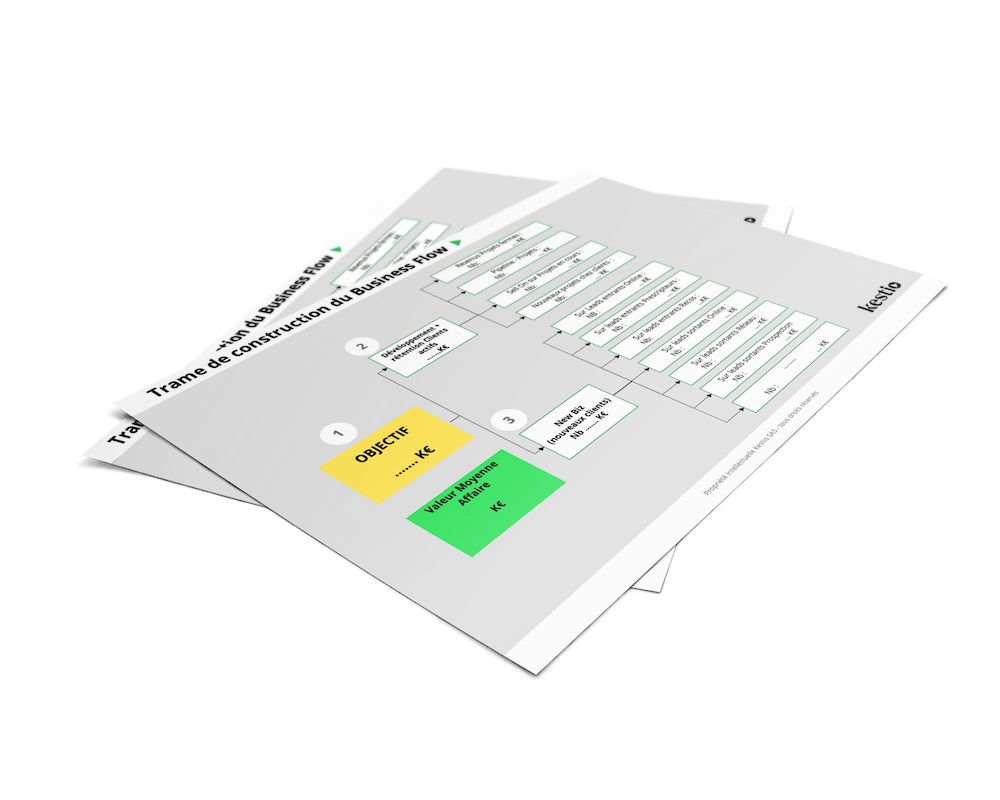
Another essential tool for the development and execution of your sales action plan is the business flow. A business flow is a tree structure, usable collectively or individually, allowing you to link and compare the implementation of your actions according to your objectives.


We suggest developing this business flow using our construction framework, which you can download and complete yourself! To download this framework, click on this link.

Did you know that 72% of B2B buyers gather information via social networks before making a purchase decision?

Implementing advertisements on these platforms can be a strategic move to increase your target audience visibility and generate leads


Leaders and prospects show a clear preference for LinkedIn, the professional network par excellence. However, the network's advertising system, LinkedIn Ads, can quickly prove difficult to master.


Explore our dedicated Webinar and learn best practices to effectively generate leads with this tool!


LinkedIn Ads: what is it?

LinkedIn Ads is LinkedIn's advertising platform. It is accessible through the Campaign Manager interface associated with your company page. The platform allows you to carry out advertising campaigns to achieve different objectives:

  • To generate leads
  • To increase the visibility of your posts
  • To increase the number of subscribers to your page


The main components of an Ad

Various elements are involved in the composition of a LinkedIn Ad, all of which can influence the effectiveness of the advertisement:

  • The budget deployed
  • Audience targeting
  • The lifespan of advertising
  • Converting contacts into leads

What is the minimum duration of an Ad? What is the cost per lead? What targeting should be done? During this Webinar, Nicolas Boissard and Anne-Charlotte Jean will share feedback and best practices to help you adjust the budget of your LinkedIn Ads to its targeting and lifespan in order to increase its conversion.


LinkedIn Ads: best practices to remember

Implementing a LinkedIn Ads campaign can be complex without significant experience in this area. That's why we're giving you some best practices to guide you in setting up your advertising strategy. 


Regarding the allocated budget, an average of 100 euros of daily budget per 50,000 people targeted is recommended to obtain good results. It is also necessary to verify that the audience corresponding to your targeting is between 100,000 and 400,000 people

Regarding the content of your advertisements, don’t hesitate to test the different formats offered by LinkedIn: text ads, display ads, conversational ads, etc. It is also important to have multiple Ads with different content and to stop those that perform the least in order to create new ones.


To discover other best practices, watch the replay of this Webinar above!


And if you want to go further in optimizing your LinkedIn Ads strategy, don't hesitate to make an appointment with Nicolas Boissard by clicking on this link to assess your situation and obtain personalized recommendations to increase your number of leads on the platform!


Webinar

4 secrets to switch to "consultative selling" mode with your customers

Fabien Comtet, CEO of KESTIO

Hosted by Fabien Comtet,

President of KESTIO


As you've probably noticed, customers are less and less available and more in control of their purchasing process.
Each of us must then develop our techniques to succeed in co-creating with them in order to involve them around our products and services.


The major sales tool, Questioning, is a real asset! It allows you to establish a "consultative selling" approach with your client and thus provoke real awareness.


Join our President Fabien Comtet in the second part of our Webinar saga "The Art of Kestioning". He'll reveal 4 secrets for mastering Kestioning techniques, used by dialogue and coaching professionals but still too little known by salespeople!


The 4 sales representative styles

Each salesperson is unique, possessing their own characteristics, strengths, and areas for improvement. However, 4 main types of salespeople can be distinguished:


  • The demonstrator, or the relational salesperson,
  • The seller, or the hunter salesperson,
  • The advisor, or the consultative salesperson,
  • The coach, or the challenger salesperson.

To move towards a « consultative selling » mode, it is then necessary for the salesperson to move towards the last two types of salespeople, without denying their natural profile. Indeed, the "consultant" and "coach" salespeople are more oriented towards the value provided. They focus on fully identifying the challenges and problems of their clients in order to offer the product and/or service with the highest added value over time. By adopting this « consultative selling » posture, the salesperson then helps the client to step back and identify solutions with them.


Want to know which type of salesperson you are? Take advantage of an exclusive discount on our individual sales assessment with the code WEBINAR50 and discover your profile! To take advantage of the discount, click here.


Consultative selling: creating an alliance with your client

To truly adopt a coaching stance, it's essential to establish a common ground of understanding between you and your client. But how do you create this alliance?

One solution is to question your client to guide them in their thinking... What result do you expect from our exchange? What is most important today? How can I help you? In consultative selling, the goal is to validate an objective with your client


To discover other keys to implementing a sales coaching approach and adopting a coaching posture, check out the replay of our Webinar!

Webinar

How to revitalize your sales?

Dominique Seguin, General Manager of KESTIO

Hosted by Dominique Seguin,

Chief Executive Officer of KESTIO


How many of you believe that far more customers should have access to your solutions?
Many of you are indeed not satisfied with your company's sales performance. What levers can you then activate to influence your sales organization?

Explore our dedicated Webinar, hosted by our General Manager, Dominique Seguin. Drawing on real testimonials from leaders, learn to identify opportunities to optimize your sales system and to better understand new customer realities!


Sales evolution: some key figures

The digital transformation we are witnessing is paving the way for a new world of sales.
Some data are particularly revealing:
– 20 billion web pages are visited every day,
– 80,000 requests are generated every second,

– 78% of LinkedIn users are between 25 and 50 years old

– Today, it takes 8 cold call attempts to reach a prospect, compared to 3.7 in 2007.


To fully benefit from these new tools offered by the Web, the digitization of your sales processes must involve significant organizational changes and new attitudes to adopt.
To gain all the keys to understanding and acting on this new dynamic, discover our white paper "Homo Sapiens Commercialis" on how to bring your sales into the digital age!


How to shift your sales into high gear?

Have you ever seen a commando decide on its own mission? Certainly not. In the sales function, the observation must be the same. Sales objectives must be a collaborative issue between the management and the sales team of your company.


Another driver of progress: methods. Changing a method is a major lever for impacting your sales performance! Indeed, if the methodologies remain static and do not adapt, the results will require much more time to be observed. It is then necessary to stay informed of the new methods available and how to apply them in your sales process.


To discover other ways to optimize your sales, watch the replay of our Webinar and register for the second part of the conference, on Tuesday, November 9th at 2:00 PM!

More than 60% of sales representatives do not consider their manager to be a good coach. Yet, which salesperson hasn't sought to improve their performance? Developing motivation, improving lead generation techniques, achieving better conversion rates, increasing the number of appointments... Like great athletes, your salespeople deserve the best coaching because there's no secret: the best get coached!


How to motivate salespeople to be coached? What golden rules should you follow during coaching? How to gain buy-in during debriefing? Discover this KESTIO Webinar where our President, Fabien Comtet, discusses techniques to increase the impact of your sales coaching.


Sales Coaching: Definition

Sales coaching refers to the observation of a company's sales activities (through its sales representatives) according to defined objectives, followed by debriefs on the methods deployed.

The goal of the practice is to get salespeople to reflect on their practices. Sales coaching is a key factor in the performance of a sales team, considering that more than one in two salespeople feel they are not sufficiently trained, coached, and supported to achieve their goals.


The first key to sales coaching: you must build rapport.

You can't coach someone who doesn't want to be coached! Your coaching must therefore be based on an alliance between you and your team. To do this, it is necessary to define a common objective for the coaching. If this alliance is not established, sales coaching will be seen more as an evaluation.


Second key to sales coaching: you will use the customer's truth

The best way to have objective data to use during your coaching is to note what the client says. The natural reaction would be to highlight what your coachee says... But this new approach allows you to give concrete examples and illustrate your coaching with a client-focused perspective!

Do you want to discover the other keys to successfully coaching your sales representatives? Watch the replay of our Webinar! Also, discover our blog article on how to define the right objectives for your sales representatives.
Do you want to move from reflection to practice? We have created a training dedicated to the posture and practices to adopt to become a coach manager. To learn more, click here.

Webinar

Marketing Automation: What Software Providers Will Never Tell You

Nicolas Boissard, Marketing Director at KESTIO and CRM expert

Hosted by Nicolas Boissard,

Marketing Director of KESTIO


Do you want to deploy a Marketing Automation solution in your company, but the overly technical jargon used by software vendors prevents you from fully identifying the features necessary for your organization?
At Kestio, we work with our clients around 4 key criteria to help them see more clearly in the jungle of Marketing Automation solutions.


Marketing Automation: Definition

The term Marketing Automation refers to all the systems used to automate marketing operations. This can range from sending emails and publishing posts on social networks to segmenting contacts and performing lead scoring.
The advantages of this automation are thus to save valuable time and to automatically identify and "nurture" your hottest prospects.
Such a system is thus generally coupled with an inbound marketing strategy and the use of a CRM solution (click on the link to participate in our dedicated Webinar on CRM tools!).


Pay attention to the technical complexity of the solutions

D’après une étude réalisée par Focus, « 50% des interrogés affirment ne pas utiliser l’intégralité des fonctionnalités de leur logiciel de Marketing Automation ». En effet, tous les logiciels ne demandent pas le même niveau de compétences techniques. 

To find the solution that best suits your needs, it is necessary to identify the level of complexity of your campaigns. The higher the level, the more features the chosen solution should have. Certain resources and skills will also need to be deployed internally.

This balance is a key element in the success of your Marketing Automation strategy! If your solution is too complex for your needs, you will lose efficiency when getting to grips with it. Conversely, if you underestimate your needs, you will quickly find your solution restrictive.

Marketing Automation is not the only answer to your marketing challenges

But deploying an effective Marketing Automation solution won't solve all your marketing problems!
On the contrary, to achieve real results, it's necessary to have a solid marketing foundation beforehand.

Your solution remains only a support for your actions! Thus, a real marketing strategy must be established, with specific objectives and targets. Your action plan must be ready to ensure the smooth running of your processes.

Once these prerequisites are met, your Marketing Automation system will finally bear fruit!

As a Sales Director, Marketing Director, President, or Business Developer, you want to review your business and your company's marketing and sales process. However, questions remain unanswered regarding the development, deployment, and impacts of your approach...
 
Explore our “Questions & Answers” Webinar hosted by our General Manager, Dominique Seguin and our Marketing Director, Nicolas Boissard. Together, they share their experiences and provide initial actionable insights to optimize your marketing and sales process.
 
  • Is it preferable to have a pipeline per salesperson or a general pipeline functioning with filters?
  • How to track leads provided by marketing and add value to them?
  • How to get a client to respond after sending a business proposal?
These are the various KESTIO questions related to the marketing and sales process discussed during this Webinar, to which Dominique and Nicolas provide initial answers.
 
Defining and developing your process is a key condition for optimizing your company's performance. A well-thought-out and relevant process allows you to reduce your expenses and minimize risks, while enabling better information flow between your teams and ensuring considerable time savings.
Without clearly defined processes, your company will struggle to identify the sources of a malfunction that prevented it from reaching a certain objective. The efficiency of your organization will be impacted and a certain decrease in motivation of your employees may be observed.
 
This webinar provides valuable tips for designing and optimizing your marketing and sales process!

Webinar

Closing: 4 techniques to encourage your customers to buy before they go on vacation


Fabien Comtet, CEO of KESTIO

Hosted by Fabien Comtet,

CEO of KESTIO


Like many sales professionals, you dream of closing deals before heading off on vacation so you can completely clear your mind.

But every year, it starts all over again... the clients you've been talking to for weeks become impossible to reach, and others call you at the last minute, hoping your response will arrive when they return from vacation...

What if you could reverse the trend and close your deals effectively?

In this Webinar, discover 4 closing techniques that drive your customers to take action.


Closing: definition

Closing simply refers to the conclusion of a sale, the moment when the contract is signed. It represents a key step in the sales process because it is at this moment that many criteria are validated, such as the price of the product and/or service. The customer may then have doubts and decide to back out. How to counter this?


Conduct an objective review of your deals

To succeed in closing, it is necessary to obtain an objective review of your current deals. To do this, ask yourself key questions that you will answer with a score between 0 and 5. Have you had regular exchanges with your client? Do you feel like you are leading the deal? Is your project feasible with your client? The answer to these different questions will allow you to define the positioning to adopt during closing.


Don't let closing happen to you

There are different ways to regain control during a poorly initiated closing. Never submitting a complete file to stay one step ahead is one of these ways. This way, the client will always have something to ask you, and you will position yourself as the leader of the exchange. But be careful not to intentionally omit key elements of the file, such as administrative resources!


Create positive tension during closing

By creating this positive tension, you will provoke a reaction from the client and prevent the closing from extending until you return from vacation. Explaining to your client that the announced rates and resources cannot be maintained past a certain date is a way to create a stimulus during closing. 

Leapfrogging the closing

The ultimate technique for closing deals is simply to adopt the mindset that you have already succeeded in closing the deal! By adopting this attitude with the client, you will psychologically guide them towards accepting the deal. Ask them about the launch date, the tools used, the next steps... so that they can envision with you a successful closing


If you would like to learn more about the power dynamic to adopt with your client, we advise you to discover our Webinar dedicated to the Key Account approach, by clicking here

Webinar

Account Based Marketing: is it for you?


Nicolas Boissard, Marketing Director at KESTIO and CRM expert

Hosted by Nicolas Boissard,

Marketing Director of KESTIO

Key Account companies are complex prospects requiring a specific approach strategy. However, the deployment of this strategy by your sales team can be critical.

Did you know that there are marketing methods to optimize and deploy your Key Account strategy?


Account Based Marketing: definition

Account Based Marketing can be translated into French as "marketing des comptes stratégiques".
This approach allows you to get in touch with high value-added prospects through highly personalized content. As the Okedito website explains, the strategy is based on setting up B2B marketing campaigns targeted at a limited number of high-potential prospects from Key Accounts.
The goal of the approach is to show your prospects that your company is the ideal solution to their needs!


The Account Based Marketing approach

Traditional marketing strategies generally seek to reach the largest number of prospects. Targeting and identifying issues only come later.
Account Based Marketing is the opposite of this strategy. Target accounts with defined needs are targeted before any communication action.

Instead of fishing with a net, we fish with a harpoon! These two strategies are still complementary and adapted to their own objectives.


The 4 key steps

1. Selection of target accounts
2. Identification of contacts
3. Nurturing
4. Conversion of the account

To help you deploy these four key steps, KESTIO offers a content pack for download. Including various templates to complete yourself, this pack allows you to enter and retain all the critical information about your target accounts, throughout your Account Based Marketing strategy. You can download this pack by clicking here.

And to take your Key Account approach strategy further, participate in our "Kestions - Answers" Webinar dedicated to this topic by clicking here.

Webinar

Onboarding a salesperson: keys to success

Dominique Seguin, General Manager of KESTIO

Hosted by Dominique Seguin,

Chief Executive Officer of KESTIO


What is onboarding?

According to Culture-RH, onboarding refers to the process of enhancing the integration of new employees. The objective is to deploy various actions that will facilitate the arrival of a new employee in the company.

However, onboarding can be time-consuming and complex. How can you be effective without overwhelming the newcomer with information? What content should you provide them with? What posture should you adopt?


What levers need to be developed to ensure successful onboarding?

To ensure the best possible integration, the manager must develop three pillars with the new salesperson: 

  • Knowledge of the company: products, internal operations, market awareness
  • The skills: sales techniques and other elements specific to the sales profession
  • Motivation: financial or otherwise

Moving from 'I know' to 'I do'

One of the keys to effective onboarding is to offer a variety of content, balancing abstraction and practical application, guidance and autonomy. For example, have your new recruit listen to podcasts and then apply two learned techniques, or ask them to give a presentation of your playbook at the next team meeting.

For the new salesperson, this approach allows them to engage many more sensory receptors and thus maximize the ability to assimilate the content and therefore succeed

The playbook: a key tool

Also called a sales book or sometimes a "sales bible," this tool outlines the main guidelines of your sales organization in writing: company strategy, sales activities, number of clients, sales pitches, etc.

Used as a reference, the playbook will allow onboarding to gain impact and speed, and to be easily reproducible.


Onboarding is therefore a key moment in the life of a sales team. The successful integration of the new member can impact the productivity of your entire team!

But once integrated, the management of the new recruit does not stop there. To discover all our resources and advice regarding the management of your team, click here.