



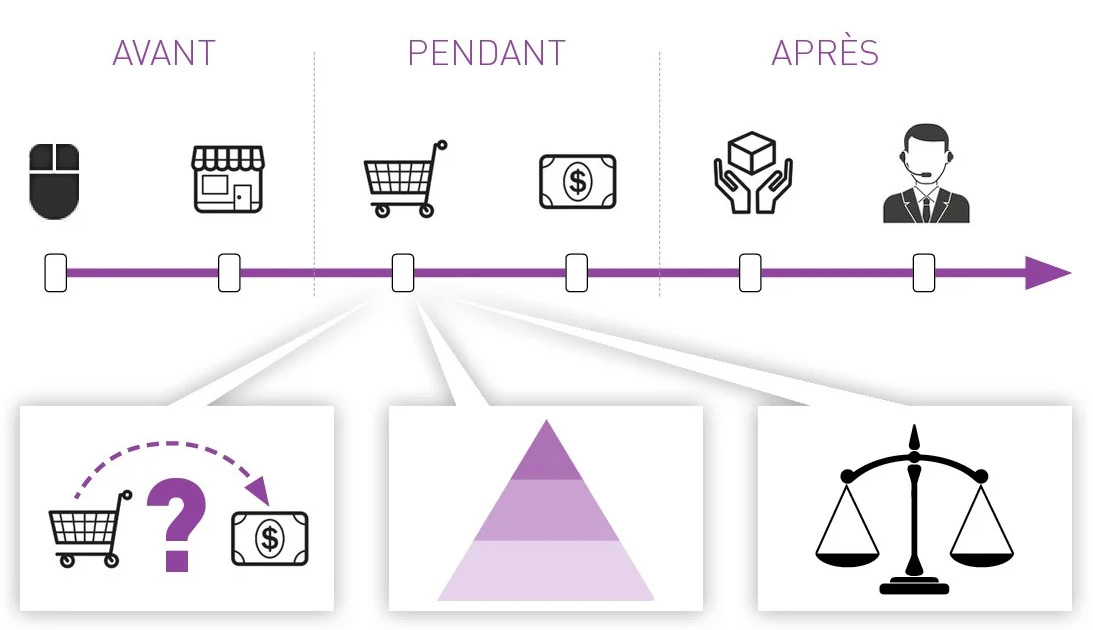
But where to begin? What actions should be implemented and what objectives should be set? Discover here (in macro view) the five key steps that will allow you to design and then deploy an effective action plan to improve the multi-channel customer journey.
1. Define the scope
To begin, there is no improvement plan without a prior assessment of the starting situation!
To improve the quality of the experience delivered to your customers, you must first measure the current level of quality and define the expected target level.
The first task therefore consists of defining the scope of the project, that is to say:
-
- Target customer segments,
- the stages of the multi-channel customer journey that you want to qualify as a priority,
- the channels involved.
2. Formalize the Journey
Once all this information is gathered, formalize the different customer journeys (one for each segment) with all their stages and contact points. You need to identify the key stages and be able to immediately and clearly visualize on each of them:
-
- the customer's actions and the channel used for each of them
- the different levels of customer needs (explicit and implicit)
- The choices the customer faces and their selection criteria
To learn everything about defining your customer journeys, (re)read our article: Define and optimize your customer journey.
3. Define the Optimal Experience framework
For each stage of the customer journey, the possible actions for the customer and the level of response provided
by the brand must then be detailed very precisely and evaluated according to a scoring system.
You will then build:
-
- your Optimal Experience repository which describes all the actions that can be taken to best meet the needs of customers,
- an observation guide that will allow you to observe and note the quality of the Customer Experience
4. Measure the quality of the delivered Experience
Measuring the quality of the experience lived by customers can be done according to different methods of observation, analysis, and scoring. For more details on this topic, we refer you to the article: Do you know how to measure the Customer Experience delivered by your brand?
Depending on the context, available resources, customer segments studied, and channels analyzed, we will favor all or part of these different methods: on-site observation of the customer journey carried out by store teams, mystery shopping, analysis of website visit and navigation statistics, analysis of verbatim and customer reviews on the internet (social networks, forums, etc.), or even eye-tracking.
In all cases, the various studies carried out will ultimately be consolidated and analyzed to extract the average scores awarded to each stage of the journey.
We can then create a model of the brand's typical customer journey and determine for each step whether the experience lived by the customer corresponds to:
-
- A disappointing moment
- A neutral moment
- An enchanting moment
Key moments identified during the definition of the customer journey will be studied with particular attention.
The average scores thus established make it possible to identify the gap between the typical customer experience offered by the brand and the target customer experience that it has set for itself.
5. Prioritize optimizing key moments!
The identified gaps ultimately allow us to target priority areas for improvement. For each of these, recommendations should be made and an action plan established.
The teams, involved from the client journey definition phase and then during the observation phase, can and should also be involved in building action plans in workshop mode.
The deployment and implementation of the action plan across the different stages of the journey, for each customer segment and on each channel, requires full and complete involvement of the various teams at each stage of the project. Prior awareness of the importance of the issues and the positive impact of these actions is therefore of crucial importance.
Discover all the levers to improve sales performance : How to activate sales performance levers
And to go further, download our White Paper on Customer Experience: