



79%.
79% of prospects are willing to share their contact information in exchange for participating in a webinar!*
Having flourished during lockdowns and the cancellation of physical events, webinars have now established themselves as a key communication and lead acquisition channel.
Whether you want to:
- Generate new leads 🧲
- Develop your visibility ⭐️
- Establish your expertise 💡
- Connect with your target audience 🤝
Carrying out a webinar is the perfect exercise for you!
However, organizing this type of event involves key steps: choosing your theme, communicating your conference, distributing the replay...
How can you ensure the success of each of these steps?
Today, we're sharing our keys to success! 🗝️
*DemandGen, 2021
STEP #1 - Choosing the theme
To ensure the success of your webinar, it is essential to carefully select the theme you will be addressing.
Avoid the temptation to include too much content! Although you have a lot of information to share, it is better to define a specific theme. Do not skim over the topics and focus on the quality of the content you offer, rather than the quantity.
To achieve this, be sure to consider the following elements when choosing your theme:
- Relevance to your target audience: The primary consideration when choosing a topic is to consider the interests and needs of your target audience.
Ask questions such as: What topics interest my audience? What problems are they trying to solve? By identifying your audience's needs, you can select a topic that sparks their interest and engagement. The more relevant the topic is to your prospects, the more likely they are to participate in your webinar.
2. Positioning Yourself as an Expert : Choosing the right theme allows you to position yourself as an expert in your field. Opt for a topic in which you have solid expertise and that allows you to share in-depth knowledge. When you present a webinar on a subject that you master, you establish your credibility and strengthen your reputation as an expert, which can generate trust and interest in your event.
3. Competitive Differentiation: It is essential to choose a theme that stands out from the competition. Research what topics have already been covered in similar webinars and identify opportunities to offer something new, unique, or innovative. By offering an original perspective or addressing a less explored aspect of a topic, you will pique the interest of potential participants looking for fresh and different information.
4. Alignment with your objectives: The chosen theme must be in harmony with the objectives you want to achieve with your webinar. Whether it's to promote a product, share knowledge, generate leads, or strengthen your brand, make sure the selected theme aligns with these objectives. It should serve your overall strategy and contribute to achieving the desired results.
5. Long-term repercussions : The choice of topic can also have long-term repercussions on your business. If you regularly organize webinars on a specific subject, this can create a certain loyalty and attract a recurring audience that is interested in your field. In addition, it can contribute to building a community around your brand and establishing lasting relationships with your audience.
Don't know which issues to choose for your future webinars?
We can help! We offer you a free 20-minute working session with our Marketing Director to identify relevant themes that are in line with your expertise and challenges.
STEP #2 - Communication
To optimally promote your webinar and maximize the number of participants, it is crucial to use multiple communication channels and implement adequate planning.
Indeed, diversifying communication channels allows you to reach a wide audience!
At the center of your different communication channels: a landing page featuring your registration form.
Then use targeted emails to invite your existing contact list or create pop-ups on your website to attract the attention of your visitors.
In parallel, leverage social media to share engaging content.
On LinkedIn, prioritize the video format or create a dedicated event to reach people outside your database!
Each communication channel has its own specific characteristics and can reach different audience segments. By diversifying your channels, you increase your chances of reaching a wider audience and optimizing your conversion rate.
Work on your copywriting

Situation:
Identify the situation or challenge your audience faces.
Obstacle:
Highlight the obstacle preventing them from reaching their goals.
Action:
Present your webinar as the action to take to overcome this obstacle
Result:
Highlight the results they can achieve by participating in your event
⚠️ Warning, once participants have registered, continue to communicate with them to maintain their engagement. Send reminder emails, generally 2 to 3, to remind them of the date and time of the webinar. Also, consider creating an event in their calendar with all the relevant information, such as the theme, date, time, and connection link. This will facilitate their planning and reduce the risk of forgetting!
By following these tips, you can effectively increase the number of participants in your webinar.
Don't forget to analyze the results of your promotional efforts!
Chez Kestio, nous organisons en moyenne une trentaine de webinars par an avec plus de 100 inscriptions en moyenne. Nous pouvons ainsi vous accompagner dans la mise en place et l’organisation de votre webinar !
STEP #3 - The live event
After attracting enough prospects (and customers) to your webinar, make way for the live event!
One watchword during your event: interactivity.
Your webinar should not be a simple online conference where your presenter recites their content, without any interaction with the participants.
Even if you don't see them, you have an audience in front of you during your live event! Don't forget this and interact with them.
Most webinar solutions (Livementor, WebinarJam, GoToWebinar, etc.) offer polling tools. Polls are a relevant way to break the ice at the beginning of a webinar and encourage your listeners to interact with you. Throughout the webinar, don't be afraid to interact directly with your audience. Ask them questions, ask for their feedback, and actively involve them in your webinar!
To achieve this, we advise you to have a moderator who can collect all the questions and comments from your participants. Their role will also be to encourage them to react to your presentation.
Some webinar formats are designed to be more interactive than others.
If your primary goal is to engage with your audience, consider these different formats:
- Webinar in pairs or in a team, in order to involve different experts on the same subject.
- Q&A session to gather all your prospects' questions about your issue.
- Experience feedback so you can put yourself in your persona's shoes.
- Interactive webinar where you involve participants in your event live.
In the end, webinars and sales are not so different!
In both cases, you need to question your audience as best as possible in order to share the solutions that are best suited to their problems.
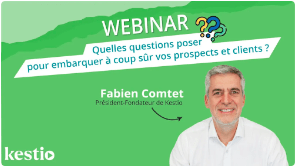
Pour vous aider à initier cette dynamique d’échange lors de vos webinars, nous vous partageons justement un webinar dédié à l’art du « Kestionnement » (comme Kestio 😉).
The parallel between sales and webinars is then easy to draw!
STEP #4: Follow-up with prospects
As you've seen, hosting a webinar is the perfect opportunity to interact directly with your audience.
But webinars allow you to go further than that and to identify prospects who are genuinely interested in your offer and therefore likely to become customers.
To achieve this, consider a Call to Action!
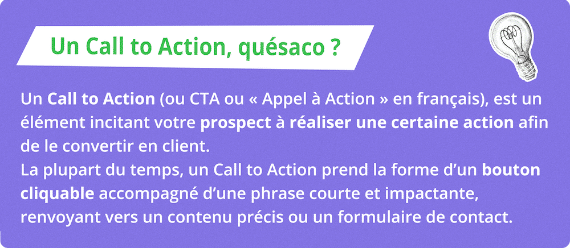
In the context of a webinar, your Call To Action can be:
- Access to the presentation support or the replay of your conference 🔁
- Downloading additional content related to the topic (such as a white paper) 📚
- Performing a demonstration of your tool ⚒️
- A direct exchange with a member of your team 💬
To carry out these different actions, your prospect will have to complete a form asking for their contact details.
As a reminder, 79% of prospects are willing to share their contact details in exchange for participation in a webinar!
The goal ? Communicate to your sales team the different prospects who have completed your CTA, and therefore are interested in your solution, so that your salespeople can interact with them.
To ensure the success of your Call to Action, your marketing and sales process must be as clear as possible:
- Distribution of the CTA at the most opportune moment (most often, at the conclusion of the webinar) ⏰
- Calling warm prospects in the days following the event 🔥
- Call pitch linked to the established Call to Action 📝
- Exchanging emails after the call ✉️
Collaboration between your marketing and sales teams will be essential for properly qualifying your prospects. Your marketing team must provide as much information as possible regarding the webinar topic and the promoted CTA, so that your sales representatives can be as relevant as possible during their interactions. Your sales team should be able to quickly contact the prospects identified during the event so that they do not forget the various topics discussed during the webinar.
How do you ensure that your marketing and sales organizations are well-aligned?
Download our diagnostic, which provides you with a score out of 5 based on various criteria (lead processing, revenue generated, etc.).
STEP #5: Expert Tip