



(If you haven't already, we invite you to rediscover the reasons why customer experience is a strategic topic and how customer delight impacts your profitability!). You likely already have an idea of the target customer experience you're aiming for, a vision and ambition in this area... But do you know where to start to achieve it? The starting point of this process invariably involves defining and optimizing your customer journey. Let's revisit the "fundamentals" of designing and evaluating customer journeys, the essential foundation for any customer experience improvement project.
1. By the way, what is the Customer Journey?
The customer journey encompasses all the stages and interaction points between a customer and a company, from the beginning of the purchasing process to the complete consumption of the product.
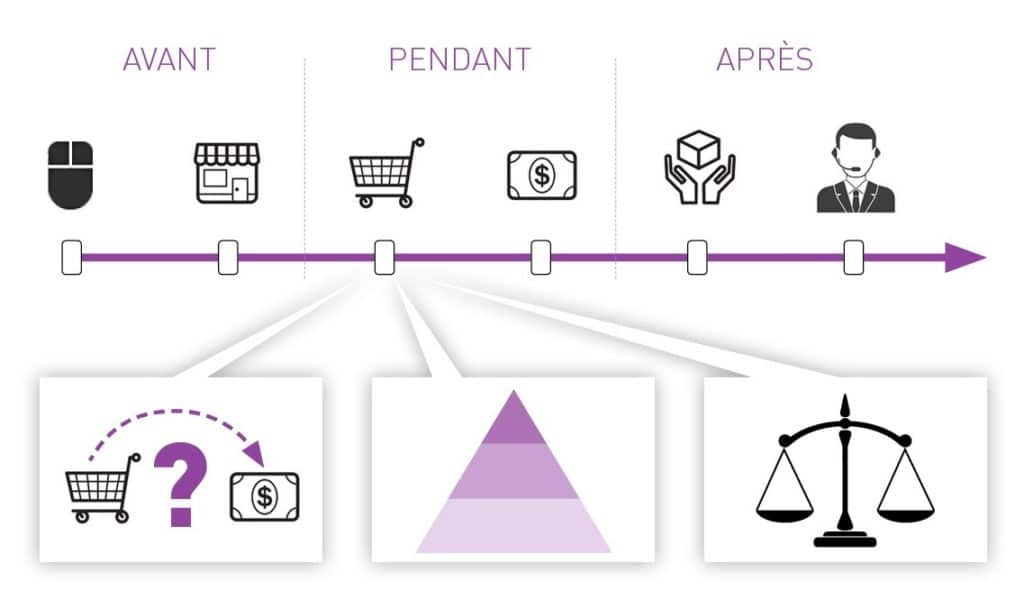
To simplify, this journey is characterized by 3 major phases:
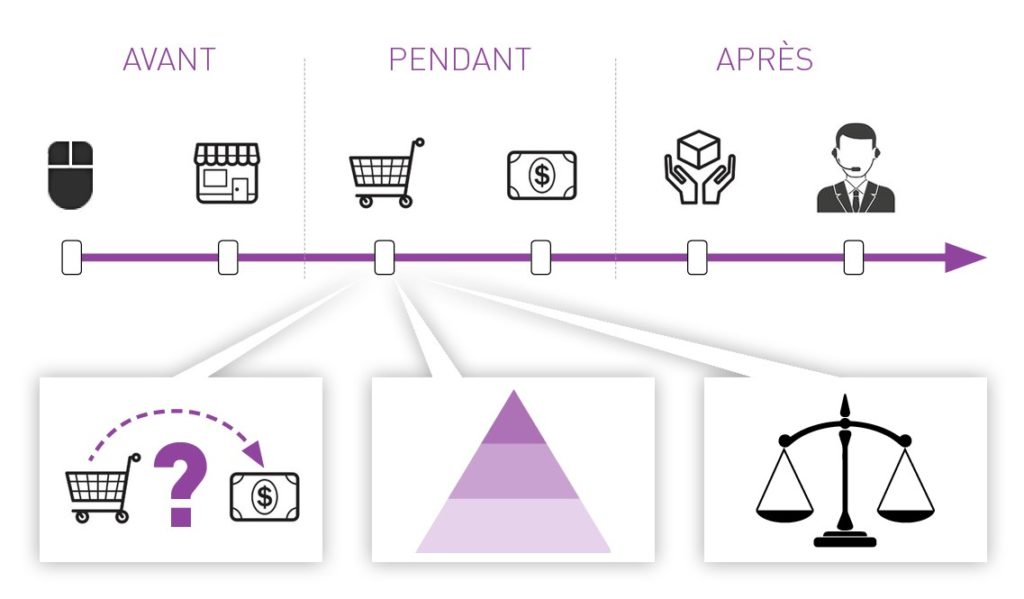
- BEFORE : all the preliminary stages, from active or passive awareness of the offer to the purchasing process, including the purchase decision phase.
- DURING: the « delivery » process, encompassing all stages of making the service or product available, its consumption, or its utilization.
- AFTER: The after-sales processes, integrating customer service, measuring customer satisfaction, and the entire relational process allowing to keep in touch and build customer loyalty.
The goal is to streamline the transition from AFTER to BEFORE.
In this sense, and even if they partially overlap, the customer journey differs from the customer lifecycle. The lifecycle is a much more macroscopic observation of the successive transition from the state of prospect to the state of active customer and finally to the state of lost customer. It can therefore contain several iterations of the customer journey, or even several journeys depending on the change in the customer's status.
2. What is the Purpose of Customer Journey Mapping?
In a customer experience improvement approach, modeling the customer journey is the first necessary step.
This enables:
-
- Identify all the stages of the journey and all the points of contact between the customer and the company,
- Determine the importance of each touchpoint in the customer experience.
- to assess the company's level of response across these touchpoints,
- to define and implement the necessary improvements in relation to the level of response desired by the company.
While this approach was initially deployed for companies in the BtoC sector, it is increasingly being replicated and adapted to companies in BtoB.
3. Define the customer journey.
There isn't necessarily just one customer journey. Depending on its customer types, the company can offer different customer journeys: this is the case, for example, for companies that have an intermediary clientele with distributors, prescribers, installers, and end consumers, or those that want to offer a very different journey to their best customers.
A point of contact is defined as an interaction between the customer and the company, via a specific channel, whether physical or digital. The interaction can be informative or transactional and triggered either by the company (push) or by the customer (pull).
This includes reading an online or magazine advertisement, receiving a promotional email, visiting the company's website, entering a store, calling customer service, receiving a package, receiving an order confirmation email, receiving an invoice, etc.
A step in the customer journey is not always linked to a point of contact. It can be experienced in the customer's journey without direct interaction with the company. For example, a recommendation by a third party on a social network, travel and transportation to the company.
4. Evaluate the level of importance of the stage in the journey
Not all steps are equal in the customer experience. It is often said that the first and last points of contact in the journey are the ones that most shape the customer's feeling, whether positive or negative. There are also other steps, often the most delicate, which, together with the first and last impressions, represent the key stages.
We call these key stages 'moments of truth,' which, depending on how the company handles them, can turn a customer into a loyal one... or a lost one.
The challenge is to meet expectations, or even exceed them, during a critical moment for the customer.
Examples: receiving a package or the return process for an e-commerce company, presenting the bill for a garage, check-in upon arrival for a hotel, product availability for a store, defending a proposal for a service company, customer service accessibility for a transport company, etc.
Satisfactorily meeting the client's expectations at these stages is a cornerstone of building loyalty. Failure to do so encourages clients to leave.
5. Evaluate the level of responsiveness to customer expectations.
It is important to assess the level of satisfaction delivered, taking into account the expectations and needs of different types of customers. Because not all customers are the same, it is necessary to identify and create customer segments according to their expectations, and even, for certain sectors of activity, to personalize the journey.
A family does not have the same needs as a couple in a ski resort, an amateur handyman does not have the same expectations as a professional in a tool shop, and an SME does not have the same expectations for its car fleet management from a rental company.
It is also essential to consider a multi-channel approach to the customer journey, respecting customers' channel preferences, and an « omnichannel » approach, enabling customers to continue their experience seamlessly across all relationship channels and with all company contacts.
Throughout all stages of the customer journey, especially during critical moments, we assist companies in measuring how well they meet customer expectations. This helps them effectively define the actions needed to improve and streamline the journey, creating customer delight.
The WelcomeExperience® method offered by KESTIO allows you to
– define multi-channel customer journeys
– assess the criticality of interaction points
– evaluate the level of satisfaction delivered
in order to develop an effective plan to improve the customer experience.