



But do you know how to leverage these tools to generate leads? To actively contribute to your sales activity, these tools must be linked to a web marketing strategy, and their use must be planned in a coordinated manner.
Here are 3 examples of effective 'sales funnels' to generate leads using your web tools.
[Reminder] What is a “sales funnel”?
If you have read our article “What if your website (finally) generated leads?”, the concept of a “sales funnel” holds no secrets for you!
If not, here's a quick summary:
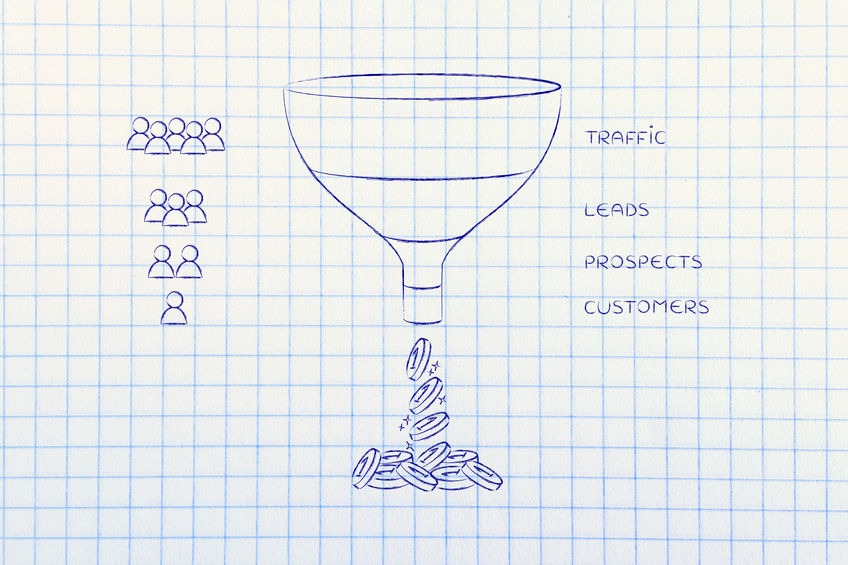
In web marketing, a "sales funnel" is a "scenario" that you have planned in advance to guide your various contacts (physical or web) to key pages of your website, in order to turn them into identified prospects.
It is based on 3 key elements:
- Attractive content for your prospects, or LEAD MAGNET
- An entry point to identify them, called LANDING PAGE
- And an email sequence designed to turn them into QUALIFIED LEADS.
How does it help to "generate leads"?
A sales funnel is built to encourage interactions with your potential prospects, once you have captured them and directed them to your website: a click, a visit to a key page, the submission of a form, etc.
The goal is to move them from the status of “unidentified visitor” to that of “identified visitor” (with a name and contact), and then transform them into “qualified leads.”
A 'qualified lead' is a contact with whom you are able to initiate a commercial exchange, that is to say: someone at whom you have detected an interest in your offer, and whose direct contact details you possess (email + telephone).
The scenario implemented involves using your web tools strategically and in a coordinated manner to enable you to validate these 2 key points.
3 examples of effective web “sales funnels”
Let's take the case of a (fictional) consulting company in the field of Customer Experience.
Here are 3 example scenarios that can be implemented to generate leads:
SCENARIO 1 – Self-assessment questionnaire
This scenario is one of the fastest and least expensive to implement. Ideal for a first approach in a 'sales funnel' logic.
- LEAD MAGNET: Self-assessment
A potential prospect visits the company's website and reads a blog article, for example: '3 Inspiring Companies in Customer Experience.' A Call-To-Action (CTA) at the bottom of the article invites them to complete an online self-assessment on the topic. For example: 'Evaluate the quality of the Customer Experience delivered by your company.'
- LANDING PAGE: Questionnaire page
The interested visitor clicks on the CTA, which redirects them to an online questionnaire. (To start, you can create your web questionnaires with a free tool, such as Google Forms).
Participation in the questionnaire requires filling in mandatory fields to receive the results: Name + Email address, and possibly optional fields: Function + Company + Phone number. (Don't forget the mandatory GDPR notices)
- EMAIL SEQUENCE: Summary of results
Two days after participating in the self-assessment, the company emails the participant a summary of the results, along with a proposal for a phone call to discuss these results and, for example, define a short-term improvement plan.
- LEAD QUALIFICATION: Appointment Scheduling
If the participant confirms the proposed phone appointment, their status changes to "qualified lead," and their contact information is forwarded to a sales representative!
SCENARIO 2 – Thematic Ebook
This scenario, which takes a little longer to implement, allows you to gradually establish a relationship with a newly identified contact and build the company's legitimacy in their eyes.
Discover KESTIO webinars, where we discuss
All topics related to sales performance with our experts:
Fabien Comtet, CEO
Dominique Seguin, CEO
Nicolas Boissard, Marketing Director
- LEAD MAGNET: EBook
A LinkedIn Ads campaign targeting 'Customer Experience Directors' on LinkedIn generates a qualified flow of visitors to an Ebook with attractive content for this audience.
For example, a 15-page report on "Customer Experience Champions".
- LANDING PAGE: Download page
Interested visitors are directed to a dedicated page, which includes a download form with mandatory fields to receive the link to the Ebook: Name + Email address, and optional fields: Job Title + Company + Phone number. (Without forgetting the mandatory GDPR notices).
- EMAIL SEQUENCE: Self-assessment
Email 1 – Sent to people who downloaded the Ebook
An initial email sent 2 days later invites them to complete an online self-assessment of their company's Customer Experience.
The participant chooses between 2 options:
Option 1
Receive a summary of the results by email
Option 2
Be contacted by phone for a personalized presentation of the results
Email 2 – Sent to people who answered the online questionnaire
A second email is sent 2 days later, containing:
Option 1
a summary of the results in PDF format with a "Call-to-Action" (CTA) encouraging them to make an appointment for a free consultation.
Option 2
An offer of an appointment for the results restitution interview, after which the summary will be sent to them.
- LEAD QUALIFICATION: Appointment Scheduling
If the participant confirms the proposed phone appointment, their status changes to "qualified lead," and their contact information is forwarded to a sales representative.
SCENARIO 3 – Conference material
As illustrated in this 3rd example, a web-based lead generation scenario can also integrate one (or more) physical touchpoint(s)!
- LEAD MAGNET: Conference material
The company's director is hosting a conference on the theme of "The New Challenges of Customer Experience."
At the end of his presentation, he invites participants to download the presentation material.
- LANDING PAGE: Download page
The conference material download page includes a form to fill out to receive the material, with the required fields: Name + Email address, and optional fields: Function + Company + Phone number.
- EMAIL SEQUENCE: Satisfaction questionnaire
Email 1 – Sent on D+2 to people who downloaded the support material
An initial message invites them to complete an online satisfaction questionnaire about the conference.
After completing the questionnaire, respondents can request a call back from an expert to define their priorities in terms of Customer Experience.
Email 2 – Sent on D+2 to people who answered the questionnaire
If the respondent has not requested a call back after completing the questionnaire, a new email is sent to them 2 days later to offer a personalized consultation again.
- LEAD QUALIFICATION: Appointment Scheduling
If the participant confirms the proposed phone appointment (at step 1 or step 2 of the email sequence), their status changes to "qualified lead," and their contact information is forwarded to a sales representative.
Each of these 3 scenarios allowed the company to identify new contacts via its website and transform some of them into qualified leads that it transmitted to its sales representatives!
In addition, the chances of conversion with these prospects are greatly increased, because:
- These individuals are already familiar with the company.
- The company has gained a certain legitimacy in their eyes.
- Sales representatives have precise information about their profile (obtained via the form, questionnaire, and interview)
Many variations of these scenarios are possible, depending on your business sector, your offers, the profile of your prospects, and the marketing tools you have. Start by deploying a 1st scenario in “test & learn” mode to generate your first leads. You can then adapt them for each of your offers and scale up!
To develop your company's communication tools, consider webinars!
The webinar allows you to highlight attractive content and thus promote the company's activity.
However, it requires a few rules: in this webinar, learn how to organize a webinar that generates more participants and leads for you.