



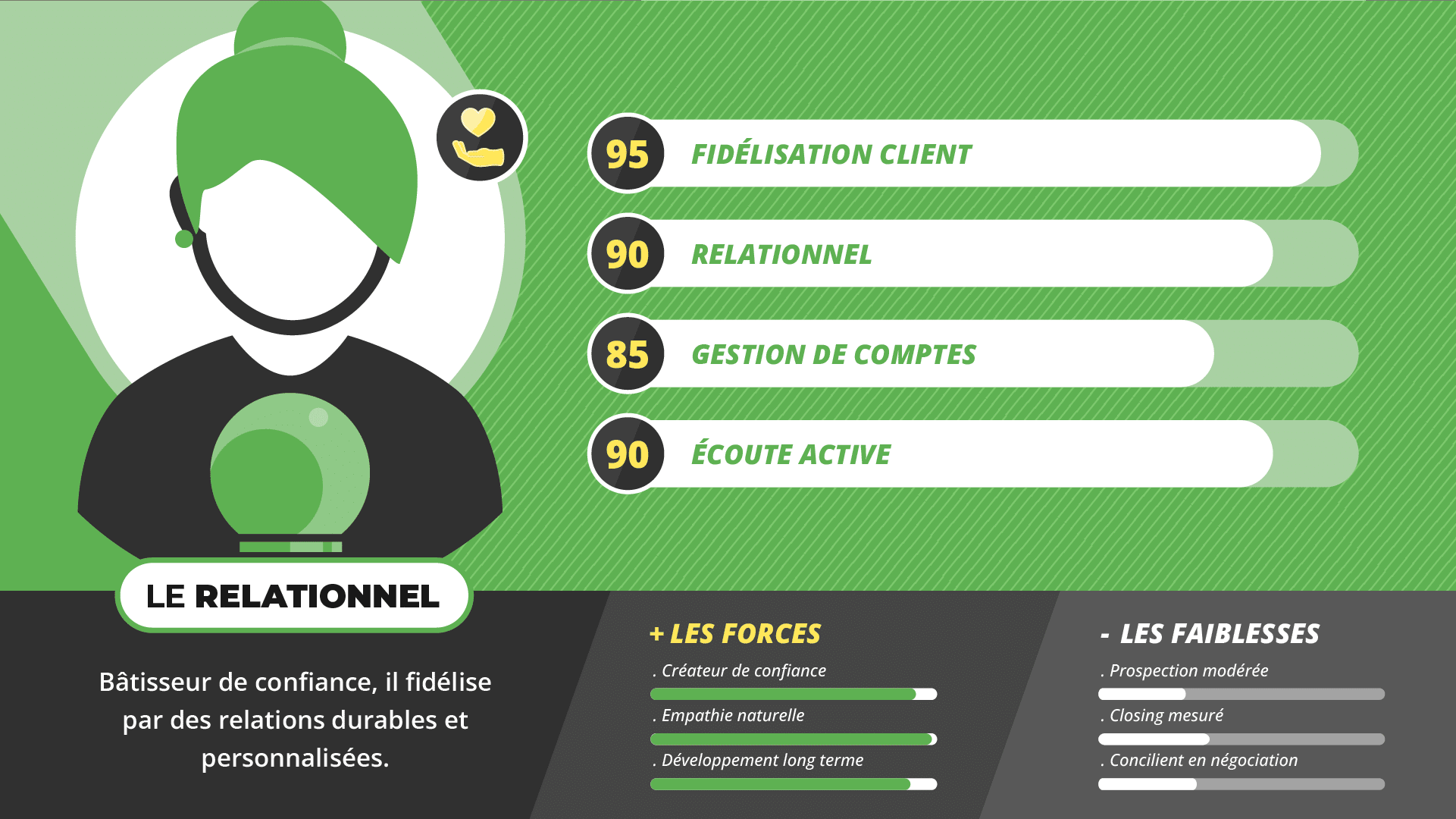
In the world of sales, some salespeople stand out for their ability to create strong and lasting relationships with their clients: this is the Relational Salesperson. More than just a salesperson, he is a trusted partner, capable of establishing genuine proximity with his contacts. His driving force? Customer satisfaction and long-term development. He excels in account management, customer loyalty, and knows how to transform a one-off sale into a long-lasting business relationship.
But this strength can also be a limitation. Uncomfortable with high-pressure sales, they may avoid confrontations and lack structure in their sales approach. Their commitment to the relationship can sometimes lead them to prioritize listening over action, or neglect pure prospecting. However, by developing more proactive reflexes and structuring their sales process, they can optimize their potential and combine relationship building with sales performance.
Discover their strengths, weaknesses, and how to maximize their impact to boost their effectiveness.
The Relational Salesperson: Sell less, get more buying.
The Relationship Salesperson is a true builder of trust. Their major asset? Their ability to create and maintain strong relationships with their clients. More than just a salesperson, they are a long-term partner who puts satisfaction and loyalty at the heart of their approach.
With active listening skills and a strong sense of customer service, they know how to anticipate expectations and offer solutions tailored to the specific needs of each contact. Their proactive approach allows them to enhance the business relationship, transforming a simple client into a loyal partner, ready to recommend their company. They prioritize networking and referrals to gain new opportunities, relying on the power of word-of-mouth and customer satisfaction to generate new business.
An expert in account management, they excel in customer follow-up, reassurance, and upselling. Their work does not stop at signing the contract: they know how to nurture the relationship, maximize satisfaction, and generate recurring sales. Their impact on the company's growth and stability is therefore considerable.
Although he is less comfortable in tense sales situations or aggressive prospecting, his ability to inspire confidence and build loyalty makes him an essential asset for any sales team.
The Relational Salesperson: The Expert in Loyalty, but at what cost?
Avoids confrontations and tense negotiations.
Focused on harmony and customer satisfaction, the Relational Salesperson may avoid difficult discussions for fear of compromising the relationship. As a result, they may hesitate to negotiate firmly, impose favorable conditions, or challenge a client on their decisions. This overly conciliatory stance can sometimes limit their commercial impact and lead them to accept disadvantageous compromises.
Dependence on their client portfolio.
Their business relies heavily on building loyalty and maintaining their network, which makes them vulnerable to market fluctuations. A change in strategy, an acquisition, or the loss of a major client can seriously impact their performance. They may also lack self-reflection, preferring to capitalize on existing relationships rather than explore new opportunities.
Difficulty prospecting and stepping outside of their comfort zone.
Unlike hunter salespeople, the Relationship-Oriented Salesperson lacks the prospecting drive. Less comfortable acquiring new clients, they may rely on their existing portfolio without actively seeking to expand it. Faced with more aggressive and daring competitors, they risk losing market share and seeing their sales growth stagnate.
To maximize their potential, they must learn to structure their approach, dare to step out of their comfort zone, and integrate more proactivity into their sales development.
How to know if you are a Relationship Salesperson?
Do you excel in account management and customer loyalty? Do you enjoy building strong relationships and ensuring regular follow-up to maximize customer satisfaction? If these elements resonate with you, there is a strong chance that you are a Relationship Salesperson.
Ask yourself these questions to be sure:
–Do you prioritize long-term customer relationships over pure prospecting?
–Do you feel more comfortable maintaining a portfolio of clients than acquiring new ones?
–Does your strength lie in listening and anticipating needs rather than direct persuasion?
–Do you prefer to develop a relationship of trust rather than pushing for a quick sale?
–Do you avoid tense negotiation situations and confrontations with your clients?
If you answered yes to several of these questions, then you very likely have the profile of a Relationship Salesperson.
Want to be sure? Take our test and discover your sales profile now!
Are you a relationship-oriented salesperson?

Commercial Relationnel : Les pistes pour mieux performer.
How to develop skills as a Relationship Salesperson?
Retaining customers is good. Structuring, prospecting, and optimizing your commercial impact is even better. To maximize results, the Relational Salesperson must refine their approach, learn to step out of their comfort zone, and balance account management with acquisition.
What are the key skills to develop?
How to avoid mistakes that limit its effectiveness?
What tools and strategies can help boost performance?
Boost your skills: Areas for improvement to work on now.
Develop your ease in prospecting.
Why? The Relationship-oriented salesperson excels in building loyalty but may lack initiative in acquiring new customers. Limiting themselves to their current portfolio can hinder their commercial growth.
How?
Define a prospecting routine with dedicated weekly slots.
Use LinkedIn Sales Navigator and qualified databases to identify new prospects suited to their relationship-building expertise.
Adopt a soft-selling approach, more natural and focused on building trust.
Structure your customer management and optimize your follow-up.
Why? Their excellent interpersonal skills are not always enough if they lack clear processes to manage their portfolio effectively.
How?
Automate reminders and follow-ups with a CRM (HubSpot, Salesforce).
Implement a structured loyalty plan (regular check-ins, proactive updates on offers, personalized support).
Anticipate future customer needs to maximize upselling and cross-selling opportunities.
Strengthen your impact in negotiation and closing.
Why? Anxious to preserve the relationship, they may avoid confrontations and lack assertiveness when closing.
How?
Use the "Collaborative Closing" method: rather than convincing, co-build the solution with the client so they commit naturally.
Practice assertive negotiation: defend your proposals without fear of highlighting the real value of your offer.
Train with negotiation scenarios to increase impact and confidence when facing objections.
Step outside your comfort zone and challenge your clients.
Why? Too focused on customer satisfaction, they may sometimes avoid challenging their contacts to avoid straining the relationship.
How?
Adopt a "consultant" stance, providing strategic insights to the client instead of simply responding to their requests.
Don't hesitate to ask more challenging questions to help your client see an opportunity from a different angle.
Incorporate consultative selling techniques like SPIN Selling to guide client decisions toward more effective solutions.
Improve organization and efficiency.
Why? Their relationship-based approach can sometimes lack structure and clear objectives, which hurts their effectiveness.
How?
Define precise KPIs (conversion rate, frequency of follow-ups, value of key accounts).
Plan actions with tools like Notion or Trello to better organize customer follow-up and opportunities.
Set portfolio expansion goals, balancing loyalty and acquisition to avoid relying solely on their current network.
Tools and methods to advance as a Relationship Sales Representative.
Management Tools: Use an effective CRM (HubSpot, Salesforce) to automate reminders and structure customer follow-up. Tools like Trello or Notion help organize actions and optimize portfolio management.
A Structured Process: Define a clear plan for loyalty, follow-up, and business development. Schedule regular check-ins with clients to identify new opportunities (upsell, cross-sell) and avoid dependence on a fixed portfolio.
A Progression Mindset: Learn to step out of your comfort zone, develop your skills in prospecting and closing, and experiment with more direct strategies to balance relationship and sales performance.
Tailored Sales Coaching
Personalized support helps to improve one's sales approach, increase impact in negotiation, and optimize the management and expansion of one's client portfolio. An external perspective can transform a good relational salesperson into a true driver of growth.
Why is it essential to know your sales profile?
Your sales profile is key to optimizing your results, refining your approach, and avoiding common mistakes.
Capitalize on your strengths: Each profile has its strengths and challenges. The Relationship-Oriented Salesperson excels in building loyalty but may struggle with prospecting or quick closing. Identifying your profile helps you strengthen your skills while working on your weaknesses.
Strengthen your sales team Understanding sales profiles improves collaboration: a Relational profile is ideal for long-term relationships, an Explorer for rapid acquisition. Properly distributing roles boosts the efficiency of the entire team.
Build a lasting customer relationship: The Relationship-Oriented Salesperson excels at listening and building trust but must also structure their actions and proactively seize opportunities. This approach transforms each client into a loyal partner.
Avoid the Pitfalls of the Relational Approach A Relational salesperson who is too passive in prospecting or not assertive enough in closing can hinder their growth. Developing these skills is essential to becoming a complete and effective sales professional.
Want to better understand your sales style? Take our test and discover your sales profile now!